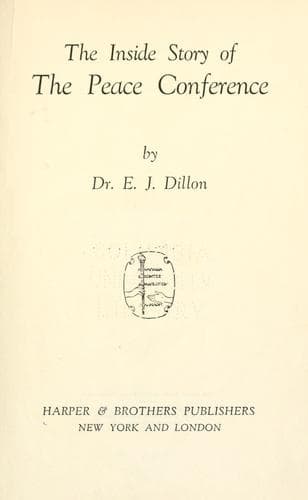
The Inside Story of the Peace ConferenceDillon, Emile Joseph
History
The Inside Story of the Peace Conference
Dillon, Emile Joseph
Paris Peace Conference (1919-1920)
whole-hearted and rigid application of the Wilsonian tenets to all
nations without exception. But even the author of these tenets did not
venture to make it.
The essence of the territorial question lay in the disposal of the
eastern shore of the Adriatic.[198] The Jugoslavs claimed all Istria and
Dalmatia, and based their claim partly on the principle of nationalities
and partly on the vital necessity of having outlets on that sea, and in
particular Fiume, the most important of them all, which they described
as essentially Croatian and indispensable as a port. The Italian
delegates, joining issue with the Jugoslavs, and claiming a section of
the seaboard and Fiume, argued that the greatest part of the East
Adriatic shore would still remain Croatian, together with all the ports
of the Croatian coast and others in southern Dalmatia--in a word, twelve
ports, including Spalato and Ragusa, and a thousand kilometers of
seaboard. The Jugoslavs met this assertion with the objection that the
outlets in question were inaccessible, all except Fiume and Metkovitch.
As for Fiume,[199] the Italian delegates contended that although not
promised to Italy by the Treaty of London, it was historically hers,
because, having been for centuries an autonomous entity and having as
such religiously preserved its Italian character, its inhabitants had
exercised their rights to manifest by plebiscite their desire to be
united with the mother country. They further denied that it was
indispensable to the Jugoslavs because these would receive a dozen other
ports and also because the traffic between Croatia and Fiume was
represented by only 7 per cent. of the whole, and even that of Croatia,
Slavonia, and Dalmatia combined by only 13 per cent. Further, Italy
would undertake to give all requisite export facilities in Fiume to the
Jugoslavs.
The latter traversed many of these statements, and in particular that
which described Fiume as a separate autonomous entity and as an
essentially Italian city. Archives were ransacked by both parties,
ancient documents produced, analyzed, condemned as forgeries or appealed
to as authentic proofs, chance phrases were culled from various writers
of bygone days and offered as evidence in support of each contention.
Thus the contest grew heated. It was further inflamed by the attitude of
Italy's allies, who appeared to her as either covertly unfriendly or at
best lukewarm.
Public-domain text, read in full here on John Shaqi.
Reviews
Reviews
No reviews yet
Be the first to share your thoughts on this work.
Elsewhere in the archive
Join the Discussion
Join the discussion
Sign in to leave a comment or review.
Sign InorCreate an account