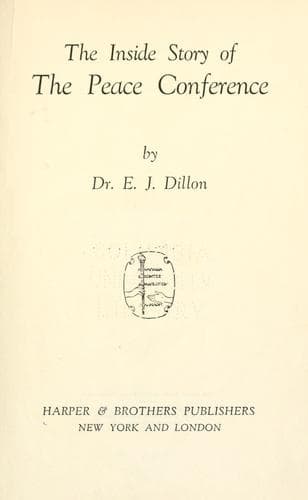
The Inside Story of the Peace ConferenceDillon, Emile Joseph
History
The Inside Story of the Peace Conference
Dillon, Emile Joseph
Paris Peace Conference (1919-1920)
frontiers, and perpetuate her political partnership with France and her
intimate relations with the Entente. Thenceforward the English-speaking
states might influence her overt acts, compel submission to their
behests, and generally exercise a sort of guardianship over her, because
they are the dispensers of economic boons, but the union of hearts, the
mutual trust, the cement supplied by common aims are lacking.
One of the most telling arguments employed by President Wilson to
dissuade various states from claiming strategic positions, and in
particular Italy from insisting on the annexation of Fiume and the
Dalmatian coast, was the effective protection which the League of
Nations would confer on them.[232] Strategical considerations would, it
was urged, lose all their value in the new era, and territorial
guaranties become meaningless and cumbersome survivals of a dead epoch.
That was the principal weapon with which he had striven to parry the
thrusts of M. Clemenceau and the touchstone by which he tested the
sincerity of all professions of faith in his cherished project of
compacting the nations of the world in a vast league of peace-loving,
law-abiding communities. But the faith of France's leaders differed
little from unbelief. Guaranties first and the protection of the League
afterward was the French formula, around which many fierce battles royal
were fought. In the end Mr. Wilson, having obtained the withdrawal of
the demand for the Rhine frontier, gave in, and the Covenant was
reinforced by a compact which in the last analysis is a military
undertaking, a unilateral Triple Alliance, Great Britain and the United
States undertaking to hasten to France's assistance should her territory
be wantonly invaded by Germany. The case thus provided for is extremely
improbable. The expansion of Germany, when the auspicious hour strikes,
will presumably be inaugurated on wholly new lines, against which
armies, even if they can be mobilized in time, will be of little avail.
But if force were resorted to, it is almost certain to be used in the
direction where the resistance is least--against France's ally, Poland.
This, however, is by the way. The point made by the Italians was that
the League of Nations being thus admittedly powerless to discharge the
functions which alone could render strategic frontiers unnecessary, can
consequently no longer be relied upon as an adequate protection against
the dangers which the possession of the strongholds she claimed on the
Adriatic would effectively displace. Either the League, it was argued,
can, as asserted, protect the countries which give up commanding
positions to potential enemies, or it cannot. In the former hypothesis
France's insistence on a military convention is mischievous and
immoral--in the latter Italy stands in as much need of the precautions
devised as her neighbor. But her spokesmen were still plied with the
threadbare arguments and bereft of the countervailing corrective. And
Public-domain text, read in full here on John Shaqi.
Reviews
Reviews
No reviews yet
Be the first to share your thoughts on this work.
Elsewhere in the archive
Join the Discussion
Join the discussion
Sign in to leave a comment or review.
Sign InorCreate an account