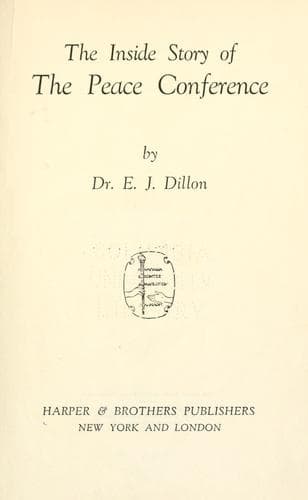
The Inside Story of the Peace ConferenceDillon, Emile Joseph
History
The Inside Story of the Peace Conference
Dillon, Emile Joseph
Paris Peace Conference (1919-1920)
faith in the efficacy of the League was sapped by the very men who were
professedly seeking to spread it.
The press of Rome, Turin, and Milan pointed to the loyalty of the
Italian people, brought out, they said, in sharp relief by the
discontent which the exclusive character of that triple military accord
engendered among them. As kinsmen of the French it was natural for
Italians to expect that they would be invited to become a party to this
league within the League. As loyal allies of Britain and France they
felt desirous of being admitted to the alliance. But they were excluded.
Nor was their exasperation allayed by the assurance of their press that
this was no alliance, but a state of tutelage. An alliance, it was
explained, is a compact by which two or more parties agree to render one
another certain services under given conditions, whereas the convention
in question is a one-sided undertaking on the part of Britain and the
United States to protect France if wantonly attacked, because she is
unable efficaciously to protect herself. It is a benefaction. But this
casuistry fell upon deaf ears. What the people felt was the
disesteem--the term in vogue was stronger--in which they were held by
the Allies, whom they had saved perhaps from ruin.
By slow degrees the sentiments of the Italian nation underwent a
disquieting change. All parties and classes united in stigmatizing the
behavior of the Allies in terms which even the literary eminence of the
poet d'Annunzio could not induce the censors to let pass. "The Peace
Treaty," wrote Italy's most influential journal, "and its correlate
forbode for the near future the Continental hegemony of France
countersigned by the Anglo-American alliance."[233] Another widely
circulated and respected organ described the policy of the Entente as a
solvent of the social fabric, constructive in words, corrosive in acts,
"mischievous if ever there was a mischievous policy. For while raising
hopes and whetting appetites, it does nothing to satisfy them; on the
contrary, it does much to disappoint them. In words--a struggle for
liberty, for nations, for the equality of peoples and classes, for the
well-being of all; in acts--the suppression of the most elementary and
constitutional liberty, the overlordship of certain nations based on the
humiliation of others, the division of peoples into exploiters and
exploited--the sharpening of social differences--the destruction of
collective wealth, and its accumulation in a few blood-stained hands,
universal misery, and hunger."[234]
Public-domain text, read in full here on John Shaqi.
Reviews
Reviews
No reviews yet
Be the first to share your thoughts on this work.
Elsewhere in the archive
Join the Discussion
Join the discussion
Sign in to leave a comment or review.
Sign InorCreate an account