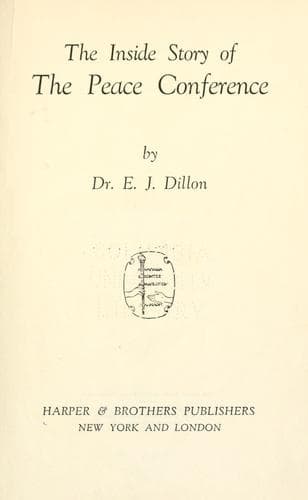
The Inside Story of the Peace ConferenceDillon, Emile Joseph
History
The Inside Story of the Peace Conference
Dillon, Emile Joseph
Paris Peace Conference (1919-1920)
Sharp comments were provoked by the heavy tax on strangers in Tunisia
imposed by the French government,[240] on strangers, mostly Italians,
who theretofore had enjoyed the same rights as the French and Tunisians.
"Suddenly," writes the principal Italian journal, "and just when it was
hoped that the common sacrifices they had made had strengthened the ties
between the two nations, the governor of Tunisia issued certain orders
which endangered the interests of foreigners and the effects of which
will be felt mainly by Italians, of whom there are one hundred and
twenty thousand in Tunisia.[241] First there came an order forbidding
the use of any language but French in the schools. Now the tax referred
to in the House of Lords gives the Tunisian government power to levy an
impost on the buying and selling of property in Tunisia. The new tax,
which is to be levied over and above pre-existing taxes, ranged from 59
per cent. of the value when it is not assessed at a higher sum than one
hundred thousand lire to 80 per cent. when its estimated value is more
than five hundred thousand lire." The article terminates with the remark
that boycotting is hardly a suitable epilogue to a war waged for common
ideals and interests.
These manifestations irritated the French and were taken to indicate
Italy's defection. It was to no purpose that a few level-headed men
pointed out that the French government was largely answerable for the
state of mind complained of. "Pertinax," in the _Echo de Paris_, wrote
"that the alliance, in order to subsist and flourish, should have
retained its character as an Anti-German League, whereas it fell into
the error of masking itself as a Society of Nations and arrogated to
itself the right of bringing before its tribunal all the quarrels of the
planet."[242] Italy's allies undoubtedly did much to forfeit her
sympathies and turn her from the alliance. It was pointed out that when
the French troops arrived in Italy the Bulletin of the Italian command
eulogized their efforts almost daily, but when the Italian troops went
to France, the _communiqués_ of the French command were most chary of
allusions to their exploits, yet the Italian army contributed more dead
to the French front than did the French army to the Italian front.[243]
At the Peace Conference, as we saw, when the terms with Germany were
being drafted, Italy's problems were set aside on the grounds that there
was no nexus between them. The Allies' interests, which were dealt with
as a whole during the war, were divided after the armistice into
essential and secondary interests, and those of Italy were relegated to
the latter class. Subsequently France, Britain, and the United States,
without the co-operation or foreknowledge of their Italian friends,
struck up an alliance from which they excluded Italy, thereby vitiating
the only arguments that could be invoked in favor of such a coalition.
When peace was about to be signed they one-sidedly revoked the treaty
Public-domain text, read in full here on John Shaqi.
Reviews
Reviews
No reviews yet
Be the first to share your thoughts on this work.
Elsewhere in the archive
Join the Discussion
Join the discussion
Sign in to leave a comment or review.
Sign InorCreate an account