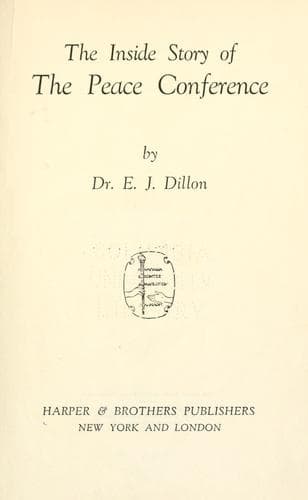
The Inside Story of the Peace ConferenceDillon, Emile Joseph
History
The Inside Story of the Peace Conference
Dillon, Emile Joseph
Paris Peace Conference (1919-1920)
which they had concluded in London, rendering the consent of all Allies
necessary to the validity of the document, and decreed that Italy's
abstention would make no difference. When the instrument was finally
signed, Mr. Wilson returned to the United States, Mr. Lloyd George to
England, and the Marquis of Saionji to Japan, without having settled any
of Italy's problems. Italy, her needs, her claims, and her policy thus
appear as matters of little account to the Great Powers. Naturally, the
Italian people were disappointed, and desirous of seeking new friends,
the old ones having forsaken them.
It would be difficult to exaggerate the consequences which this attitude
of the Allies toward Italy may have on European politics generally. Her
most eminent statesman, Signor Tittoni, who succeeded Baron Sonnino,
transcending his country's mortifications, exerted himself tactfully and
not unsuccessfully to lubricate the mechanism of the alliance, to ease
the dangerous friction and to restore the tone. And he seems to have
accomplished in these respects everything which a sagacious statesman
could do. But to arrest the operation of psychological laws is beyond
the power of any individual. In order to appreciate the Italian point of
view, it is nowise necessary to approve the exaggerated claims put
forward by her press in the spring of 1919. It is enough to admit that
in the light of the Wilsonian doctrine they were not more incompatible
with that doctrine than the claims made by other Powers and accorded by
the Supreme Council.
To sum up, Italy acquired the impression that association with her
recent allies means for her not only sacrifices in their hour of need,
but also further sacrifices in their hour of triumph. She became
reluctantly convinced that they regard interests which she deems vital
to herself as unconnected with their own. And that was unfortunate. If
at some fateful conjuncture in the future her allies on their part
should gather the impression that she has adjusted her policy to those
interests which are so far removed from theirs, they will have
themselves to blame.
FOOTNOTES:
[194] This clause, which figured in the draft Treaty, as presented to
the Germans, provoked such emphatic protests from all sides that it was
struck out in the revised version.
[195] In an interview given to the Correspondenz Bureau of Vienna by
Conrad von Hoetzendorff. Cf. _Le Temps_, July 19, 1919.
[196] The Prime Minister, Salandra, declared that to have made
neutrality a matter of bargaining would have been to dishonor Italy.
[197] King Carol was holding a crown council at the time. Bratiano had
spoken against the King's proposal to throw in the country's lot with
Germany. Carp was strongly for carrying out Rumania's treaty
obligations. Some others hesitated, but before it could be put to the
vote a telegram was brought in announcing Italy's resolve to maintain
neutrality. The upshot was Rumania's refusal to follow her allies.
Public-domain text, read in full here on John Shaqi.
Reviews
Reviews
No reviews yet
Be the first to share your thoughts on this work.
Elsewhere in the archive
Join the Discussion
Join the discussion
Sign in to leave a comment or review.
Sign InorCreate an account