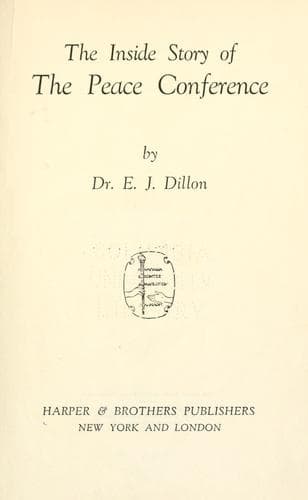
The Inside Story of the Peace ConferenceDillon, Emile Joseph
History
The Inside Story of the Peace Conference
Dillon, Emile Joseph
Paris Peace Conference (1919-1920)
The delegates were not all discouraged by their discomfiture over the
Prinkipo project. Some of them still hankered after an agreement with
the Bolshevists which would warrant them in including the Russian
problem among the tasks provisionally achieved. President Wilson
despatched secret envoys to Moscow to strike up an accord with
Lenin,[268] but although the terms which Mr. Bullitt obtained were those
which had in advance been declared satisfactory, he drew back as soon as
they were agreed to. And he assigned no reason for this change of
attitude. Whether the brightening of the prospects of Kolchak and
Denikin had modified his judgment on the question of expediency must
remain a matter of conjecture. It is hardly necessary, however, to point
out once more that this sudden improvisation of schemes which were
abandoned again at the last moment tended to lower the not particularly
high estimate set by the ethnic wards of the Anglo-Saxon peoples on the
moral guidance of their self-constituted guardians.
An ardent champion of the Allied nations in France wrote: "We have never
had a Russian policy which was all of one piece. We have never
synthetized any but contradictory conceptions. This is so true that one
may safely affirm that if Russian patriotism has been sustained by our
velleities of action, Russian destructiveness has been encouraged by our
velleities of desertion. We joined, so to say, both camps, and our
velleities of desertion occasionally getting the upper hand of our
velleities of action ... we carry out nothing."[269]
Toward Kolchak and Denikin the attitude of the Supreme Council varied
considerably. It was currently reported in Paris that the Admiral had
had the misfortune to arouse the displeasure of the two Conference
chiefs by some casual manifestation of a frame of mind which was
resented, perhaps a movement of independence, to which distance or the
medium of transmission imparted a flavor of disrespect. Anyhow, the
Russian leader was for some time under a cloud, which darkened the
prospects of his cause. And as for Denikin, he appeared to the other
great delegate as a self-advertising braggart.
Public-domain text, read in full here on John Shaqi.
Reviews
Reviews
No reviews yet
Be the first to share your thoughts on this work.
Elsewhere in the archive
Join the Discussion
Join the discussion
Sign in to leave a comment or review.
Sign InorCreate an account