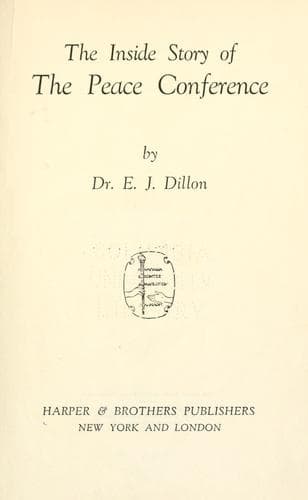
The Inside Story of the Peace ConferenceDillon, Emile Joseph
History
The Inside Story of the Peace Conference
Dillon, Emile Joseph
Paris Peace Conference (1919-1920)
These mental portraits were retouched as the fortune of war favored the
pair. And their cause benefited correspondingly. To this improvement
influences at work in London contributed materially. For the
anti-Bolshevist currents which made themselves felt in certain state
departments in that capital, where there were several irreconcilable
policies, were powerful and constant. By the month of May the Conference
had turned half-heartedly from Lenin and Trotzky to Kolchak and Denikin,
but its mode of negotiating bore the mark peculiar to the diplomacy of
the new era of "open covenants openly arrived at." The delegates in
Paris communicated with the two leaders in Russia "over the heads" and
without the knowledge of their authorized representatives in Paris, just
as they had issued peremptory orders to "the Rumanian government at
Bucharest" over the heads of its chiefs, who were actually in the French
capital.
The proximate motives that determined several important decisions of
the Secret Council, although of no political moment, are of sufficient
psychological interest to warrant mention. They shed a light on the
concreteness, directness, and simplicity of the workings of the
statesmen's minds when engaged in transacting international business.
For example, the particular moment for the recognition of new
communities as states was fixed by wholly extrinsical circumstances. A
food-distributer, for instance, or the Secretary of a Treasury, wanted a
receipt for expenditure abroad from the people that benefited by it. As
a document of this character presupposes the existence of a state and a
government, the official dispenser of food or money was loath to go to
the aid of any nation which was not a state or which lacked a properly
constituted government. Hence, in some cases the Conference had to
create both on the spur of the moment. Thus the reason why Finland's
independence received the hall-mark of the Powers when it did was
because the United States government was generously preparing to give
aid to the Finns and had to get in return proper receipts signed by
competent authorities representing the state.[270] Had it not been for
this immediate need of valid receipts, the act of recognition might have
been postponed in the same way as was the marking off of the frontiers.
And like considerations led to like results in other cases.
Czechoslovakia's independence was formally recognized for the same
reason, as one of its leading men frankly admitted.
Public-domain text, read in full here on John Shaqi.
Reviews
Reviews
No reviews yet
Be the first to share your thoughts on this work.
Elsewhere in the archive
Join the Discussion
Join the discussion
Sign in to leave a comment or review.
Sign InorCreate an account