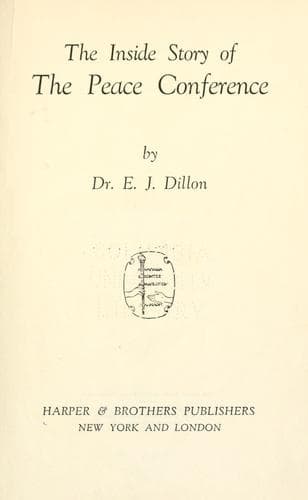
The Inside Story of the Peace ConferenceDillon, Emile Joseph
History
The Inside Story of the Peace Conference
Dillon, Emile Joseph
Paris Peace Conference (1919-1920)
neither of these obnoxious riders was included, so that the proposal
assumed a different aspect.
Another example of these singular tactics is supplied by their
_pourparlers_ with the Admiral's delegates about the future
international status of Finland, whose help was then being solicited to
free Petrograd from the Bolshevist yoke. The Finns insisted on the
preliminary recognition of their complete independence by the Russians.
Kolchak's representatives shrank from bartering any territories which
had belonged to the state on their own sole responsibility. None the
less, as the subject was being theoretically threshed out in all its
bearings, the members of the Russian Council in Paris inquired of the
Allies whether the Finns had at least renounced their pretensions to the
province of Karelia. But the spokesmen of the Conference replied
elusively, giving them no assurance that the claim had been
relinquished. Thereupon they naturally concluded that the Finns either
still maintained their demand or else had not yet modified their former
decision on the matter, and they deemed it their duty to report in this
sense to their chief. Yet the plenipotentiaries, in their message on the
subject to Kolchak, which was sent about the same time, assured him that
the annexation of Karelia was no longer insisted upon, and that the
Finns would not again put forward the claim! One hardly knows what to
think of tactics like these. In their talks with the spokesmen of
certain border states of Russia the official representatives of the
three European Powers at the Conference employed language that gave rise
to misunderstandings which may have untoward consequences in the future.
One would like to believe that these misunderstandings were caused by
mere slips of the tongue, which should not have been taken literally by
those to whom they were addressed; but in the meanwhile they have become
not only the source of high, possibly delusive, hopes, but the basis of
elaborate policies. For example, Esthonian and Lettish Ministers were
given to understand that they would be permitted to send diplomatic
legations to Petrograd as soon as Russia was reconstituted, a mode of
intercourse which presupposes the full independence of all the countries
concerned. A constitution was also drawn up for Esthonia by one of the
Great Powers, which started with the postulate that each people was to
be its own master. Consequently, the two nations in question were
warranted in looking forward to receiving that complete independence.
And if such was, indeed, the intention of the Great Powers, there is
nothing further to be said on the score of straightforwardness or
precision. But neither in the terms submitted to Kolchak nor in those to
which his Paris agents were asked to give their assent was the
independence of either country as much as hinted at.[272]
Public-domain text, read in full here on John Shaqi.
Reviews
Reviews
No reviews yet
Be the first to share your thoughts on this work.
Elsewhere in the archive
Join the Discussion
Join the discussion
Sign in to leave a comment or review.
Sign InorCreate an account