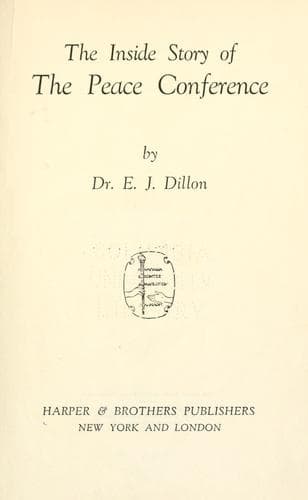
The Inside Story of the Peace ConferenceDillon, Emile Joseph
History
The Inside Story of the Peace Conference
Dillon, Emile Joseph
Paris Peace Conference (1919-1920)
When the revolution broke out Kolchak was at Sebastopol. The telegram
conveying the sensational tidings of the outbreak was kept secret by all
military commanders--except himself. He unhesitatingly summoned the
soldiers and sailors, apprised them of what had taken place, gave them
an insight into the true meaning of the violent upheaval, and asked them
to join with him in a heroic endeavor to influence the course of things,
in the direction of order and consolidation. He gaged aright the
significance of the revolution and the impossibility of confining it
within any bounds, political, moral, or geographical. But he reasoned
that a band of resolute patriots might contrive to wrest something for
the country from the hands of Fate. It was with this faith and hope that
he set to work, and soon his valiant army, the reclaimed provinces, and
the improved Russian outlook were eloquent witnesses to his worth, whose
testimony no legendary reports, however well received in the West, could
weaken.
How ingrained in the plenipotentiaries was their proneness for what, for
want of a better word, may be termed conspirative and circuitous action
may be inferred from the record of their official and unofficial
conversations and acts. When holding converse with Kolchak's authorized
agents in Paris they would lay down hard conditions, which were
described as immutable; and yet when communicating with the Admiral
direct they would submit to him terms considerably less irksome, unknown
to his Paris advisers, thus mystifying both and occasioning friction
between them. In many cases the contrast between the two sets of demands
was disconcerting, and in all it tended to cause misunderstandings and
complicate the relations between Kolchak and his Paris agents. But he
continued to give his confidence to his representatives, although they
were denied that of the delegates. It would, of course, be grossly
unfair to impute anything like disingenuousness to plenipotentiaries
engaged upon issues of this magnitude, but it was an unfortunate
coincidence that they were known to regard some of the members of the
Russian Council in Paris with disfavor, and would have been glad to see
them superseded. When Nansen's project to feed the starving population
of Russia was first mooted, Kolchak's Ministers in Paris were approached
on the subject, and the Allies' plan was propounded to them so
defectively or vaguely as to give them the impression that the
co-operation of the Bolshevist government was part of the program. They
were also allowed to think that during the work of feeding the people
the despatch of munitions and other military necessaries to Kolchak and
his army would be discontinued. Naturally, the scheme, weighted with
these two accompaniments, was unacceptable to Kolchak's representatives
in Paris. But, strange to say, in the official notification which the
plenipotentiaries telegraphed at the same time to the Admiral direct,
Public-domain text, read in full here on John Shaqi.
Reviews
Reviews
No reviews yet
Be the first to share your thoughts on this work.
Elsewhere in the archive
Join the Discussion
Join the discussion
Sign in to leave a comment or review.
Sign InorCreate an account