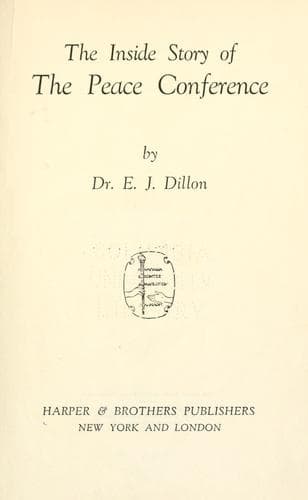
The Inside Story of the Peace ConferenceDillon, Emile Joseph
History
The Inside Story of the Peace Conference
Dillon, Emile Joseph
Paris Peace Conference (1919-1920)
No one who has followed attentively the work of the constitution-makers
in Weimar can have overlooked their readiness to adopt and assimilate
the positive elements of a movement which was essentially destructive.
In this respect they displayed a remarkable degree of open-mindedness
and receptivity. They showed themselves avid of every contribution which
they could glean from any source to the work of national reorganization,
and even in Teutonized Bolshevism they apparently found helpful hints of
timely innovations. One may safely hazard the prediction that these
adaptations, however little they may be relished, are certain to spread
to the Western peoples, who will be constrained to accept them in the
long run, and Germany may end by becoming the economic leader of
democratic Europe. The law of politico-social interchange and
assimilation underlying this phenomenon, had it been understood by the
statesmen of the Entente, might have rendered them less desirous of
seeing the German organism tainted with the germs of dissolution. For
what Germany borrows from Bolshevism to-day western Europe will borrow
from Germany to-morrow. And foremost among the new institutions which
the revolution will impose upon Europe is that of the Soviets,
considerably modified in form and limited in functions.
"In the conception of the Soviet system," writes the most influential
Jewish-German organ in Europe, "there is assuredly something
serviceable, and it behooves us to familiarize ourselves therewith.
Psychologically, it rests upon the need felt by the working-man to be
something more than a mere cog in the industrial mechanism. The first
step would consist in conferring upon labor committees juridical
functions consonant with latter-day requirements. These functions would
extend beyond those exercised by the labor committees hitherto. How far
they could go without rendering the industrial enterprise impossible is
a matter for investigation.... This is not merely a wish of the
extremists; it is a psychological requirement, and therefore it
necessitates the establishment of a closer nexus between legislation and
practical life which unhappily is become so complicated. And this need
is not confined to the laboring class. It is universal. Therefore, what
is good for the one is meet for the other."[276]
The Soviet system adapted to modern existence is one--and probably the
sole--legacy of Bolshevism to the new age.
Public-domain text, read in full here on John Shaqi.
Reviews
Reviews
No reviews yet
Be the first to share your thoughts on this work.
Elsewhere in the archive
Join the Discussion
Join the discussion
Sign in to leave a comment or review.
Sign InorCreate an account