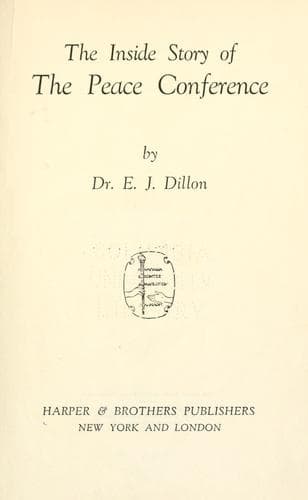
The Inside Story of the Peace ConferenceDillon, Emile Joseph
History
The Inside Story of the Peace Conference
Dillon, Emile Joseph
Paris Peace Conference (1919-1920)
During the Peace Conference Bolshevism played a large part in the
world's affairs. By some of the eminent lawgivers there it was feared as
a scourge; by others it was wielded as a weapon, and by a third set it
was employed as a threat. Whenever a delegate of one of the lesser
states felt that he was losing ground at the Peace Table, and that his
country's demands were about to be whittled down as extravagant, he
would point significantly to certain "foretokens" of an outbreak of
Bolshevism in his country and class them as an inevitable consequence of
the nation's disappointment. Thus the representative of nearly every
state which had a territorial program declared that that program must be
carried out if Bolshevism was to be averted there. "This or else
Bolshevism" was the peroration of many a delegate's _exposé_. More
redoubtable than political discontent was the proselytizing activity of
the leaders of the movement in Russia.
Of the two pillars of Bolshevism one is a Russian, the other a Jew, the
former, Ulianoff (better known as Lenin), the brain; the other,
Braunstein (called Trotzky), the arm of the sect. Trotzky is an
unscrupulous despot, in whose veins flows the poison of malignity. His
element is cruelty, his special gift is organizing capacity. Lenin is a
Utopian, whose fanaticism, although extensive, has well-defined limits.
In certain things he disagrees profoundly with Trotzky. He resembles a
religious preacher in this, that he created a body of veritable
disciples around himself. He might be likened to a pope with a college
of international cardinals. Thus he has French, British, German,
Austrian, Czech, Italian, Danish, Swedish, Japanese, Hindu, Chinese,
Buryat, and many other followers, who are chiefs of proselytizing
sections charged with the work of spreading the Bolshevik evangel
throughout the globe, and are working hard to discharge their duties.
Lenin, however, dissatisfied with the measures of success already
attained, is constantly stimulating his disciples to more strenuous
exertions. He shares with other sectarian chiefs who have played a
prominent part in the world's history that indefinable quality which
stirs emotional susceptibility and renders those who approach him more
easily accessible to ideas toward which they began by manifesting
repugnance. Lenin is credibly reported to have made several converts
among his Western opponents.
Public-domain text, read in full here on John Shaqi.
The Inside Story of the Peace Conference — John Shaqi
Reviews
Reviews
No reviews yet
Be the first to share your thoughts on this work.
Elsewhere in the archive
Join the Discussion
Join the discussion
Sign in to leave a comment or review.
Sign InorCreate an account