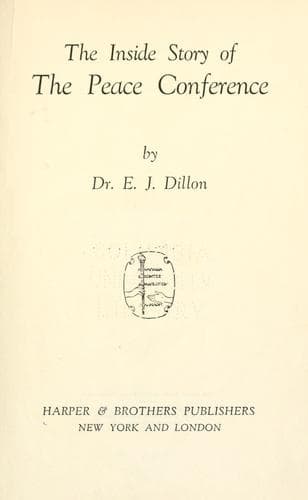
The Inside Story of the Peace ConferenceDillon, Emile Joseph
History
The Inside Story of the Peace Conference
Dillon, Emile Joseph
Paris Peace Conference (1919-1920)
But it is common knowledge that the Bolshevist dictator requisitioned
and "nationalized" the banks, took factories, workshops, and plants from
their owners and handed them over to the workmen, deprived landed
proprietors of their estates, and allowed peasants to appropriate them.
It is in the matter of industry, however, that his experiment is most
interesting as showing the practical value of Marxism as a policy and
the ability of the Bolsheviki to deal with delicate social problems. The
historic decree issued by the Moscow government on the nationalization
of industry after the opening experiment had broken down contains data
enough to enable one to affirm that Lenin himself judged Marxism
inapplicable even to Russia, and left it where he had found it--among
the ideals of a millennial future. That ukase ordered the gradual
nationalization of all private industries with a capital of not less
than one million rubles, but allowed the owners to enjoy the gratuitous
usufruct of the concern, provided that they financed and carried it on
as before. Consequently, although in theory the business was transferred
to the state, in reality the capitalist retained his place and his
profits as under the old system. Consequently, the principal aims of
socialism, which are the distribution of the proceeds of industry among
the community and the retention of a certain surplus by the state, were
missed. In the Bolshevist procedure the state is wholly eliminated
except for the purpose of upholding a fiction. It receives nothing from
the capitalist, not even a royalty.
Public-domain text, read in full here on John Shaqi.
Reviews
Reviews
No reviews yet
Be the first to share your thoughts on this work.
Elsewhere in the archive
Join the Discussion
Join the discussion
Sign in to leave a comment or review.
Sign InorCreate an account