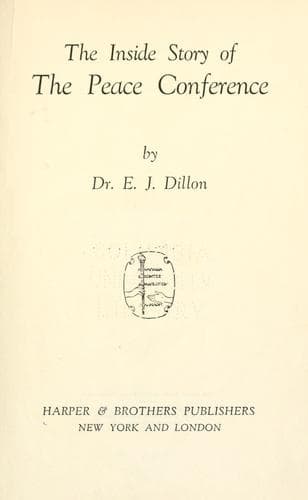
The Inside Story of the Peace ConferenceDillon, Emile Joseph
History
The Inside Story of the Peace Conference
Dillon, Emile Joseph
Paris Peace Conference (1919-1920)
In its milder manifestations on the social side Russian Bolshevism
resembles communism, and may be described as a social revolution
effected by depriving one set of people--the ruling and intelligent
class--of power, property, and civil rights, putting another and less
qualified section in their place, and maintaining the top-heavy
structure by force ruthlessly employed. Far-reaching though this change
undoubtedly is, it has no nexus with Marxism or kindred theories. Its
proximate causes were many: such, for example, as the breakdown of a
tyrannical system of government, state indebtedness so vast that it
swallowed up private capital, the depreciation of money, and the
corresponding appreciation of labor. It is fair, therefore, to say that
a rise in the cost of production and the temporary substitution of one
class for another mark the extent to which political forces
revolutionized the social fabric. Beyond these limits they did not go.
The notion had been widespread in most countries, and deep-rooted in
Russia, that a political upheaval would effect a root-reaching and
lasting alteration in the forces of social development. It was adopted
by Lenin, a fanatic of the Robespierre type, but far superior to
Robespierre in will-power, insight, resourcefulness, and sincerity, who,
having seized the reins of power, made the experiment.
It is no easy matter to analyze Lenin's economic policy, because of the
veil of mist that conceals so much of Russian contemporary history. Our
sources are confined to the untrustworthy statements of a censored press
and travelers' tales.
Public-domain text, read in full here on John Shaqi.
Reviews
Reviews
No reviews yet
Be the first to share your thoughts on this work.
Elsewhere in the archive
Join the Discussion
Join the discussion
Sign in to leave a comment or review.
Sign InorCreate an account