Comedy plays; Russia -- Social life and customs -- Drama; Russian drama -- Translations into English
Produced by Judy Boss
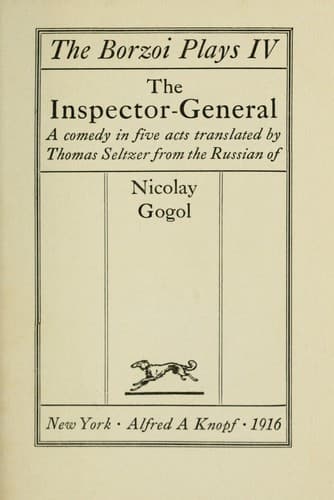
THE INSPECTOR-GENERAL
By Nicolay Gogol
A comedy in five acts
Translated by Thomas Seltzer from the Russian
INTRODUCTION
The Inspector-General is a national institution. To place a purely
literary valuation upon it and call it the greatest of Russian comedies
would not convey the significance of its position either in Russian
literature or in Russian life itself. There is no other single work in
the modern literature of any language that carries with it the wealth of
associations which the Inspector-General does to the educated Russian.
The Germans have their Faust; but Faust is a tragedy with a cosmic
philosophic theme. In England it takes nearly all that is implied in the
comprehensive name of Shakespeare to give the same sense of bigness that
a Russian gets from the mention of the Revizor.
That is not to say that the Russian is so defective in the critical
faculty as to balance the combined creative output of the greatest
English dramatist against Gogol's one comedy, or even to attribute to
it the literary value of any of Shakespeare's better plays. What the
Russian's appreciation indicates is the pregnant role that literature
plays in the life of intellectual Russia. Here literature is not a
luxury, not a diversion. It is bone of the bone, flesh of the flesh, not
only of the intelligentsia, but also of a growing number of the common
people, intimately woven into their everyday existence, part and parcel
of their thoughts, their aspirations, their social, political and
economic life. It expresses their collective wrongs and sorrows, their
collective hopes and strivings. Not only does it serve to lead the
movements of the masses, but it is an integral component element of
those movements. In a word, Russian literature is completely bound up
with the life of Russian society, and its vitality is but the measure of
the spiritual vitality of that society.
This unique character of Russian literature may be said to have had its
beginning with the Inspector-General. Before Gogol most Russian writers,
with few exceptions, were but weak imitators of foreign models.
The drama fashioned itself chiefly upon French patterns. The
Inspector-General and later Gogol's novel, Dead Souls, established that
tradition in Russian letters which was followed by all the great writers
from Dostoyevsky down to Gorky.
Public-domain text, read in full here on John Shaqi.
Reviews
Reviews
No reviews yet
Be the first to share your thoughts on this work.
Join the Discussion
Join the discussion
Sign in to leave a comment or review.
Sign InorCreate an account