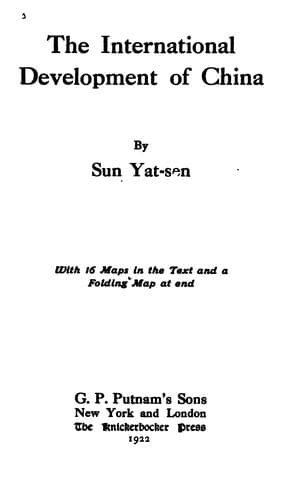
The International Development of ChinaSun, Yat-sen
History
The International Development of China
Sun, Yat-sen
China -- Economic conditions -- 1912-1949; Railroads -- China
This line starts from Chensi and proceeds southwestward along the
Tienshan pasture through Yenanpoa, Shihkialoong, and Taolaitse
to Chikoching, then along the Tienshan forest through Wutungkwo,
Tungyenchi, Siyenchi, and Olong to Sensien, where it crosses the
Central Trunk line. After Sensien it proceeds along the northern edge
of the Tarim Desert through Lakesun City and Shehchuan to Hora, where
it crosses the Cherchen-Koria line. From Hora the line proceeds along
the course of the Tarim River, passing by many new settlements, fertile
regions, and virgin forests, to Bastutakelak, where it crosses the
Ili-Hotien line. Thence it goes through Pachu to Kashgar where it meets
the Urumochi-Iden line. After Kashgar it proceeds northwestward to
the frontier where it ends. Attached to this line are two branches.
The first branch proceeds from Hora southwestward through many oases
to Cherchen. The second proceeds from Pachu southwestward along the
Yarkand River to Sache and then westward to Puli near the frontier.
This line including the branches covers a distance of about 1,600
miles. The total length of this entire system is about 16,000 miles.
See general map.
PART V
The Highland Railway System
This, the last part of my railway program, is the most difficult and
most expensive undertaking of its kind; consequently, it must be the
least remunerative of all the railway enterprises in China. So no
work should be attempted in this part until all the other parts are
fully developed. But when all the other parts are well equipped with
railways then railway construction in this highland region will also be
remunerative, despite the difficulties and the highly expensive work in
construction.
The highland region consists of Tibet, Kokonor, and a part of
Sinkiang, Kansu, Szechwan, and Yunnan, an area of about 1,000,000
square miles. Tibet is known to be the richest country in the world
for gold deposits. Furthermore the adjacent territories possess rich
agricultural and pastural lands. This vast region is little known to
the outside world. The Chinese call Tibet "the Western Treasury,"
for, besides gold, there are other kinds of metals especially copper,
in great quantities. Indeed the name of the Western Treasury is most
appropriately applied to this unknown region. When the world's supply
of precious metals are exhausted, we have to resort to this vast
mineral bearing region for supply. So railways will be necessary at
least for mining purposes. I therefore propose the following lines:
Public-domain text, read in full here on John Shaqi.
Reviews
Reviews
No reviews yet
Be the first to share your thoughts on this work.
Elsewhere in the archive
Join the Discussion
Join the discussion
Sign in to leave a comment or review.
Sign InorCreate an account