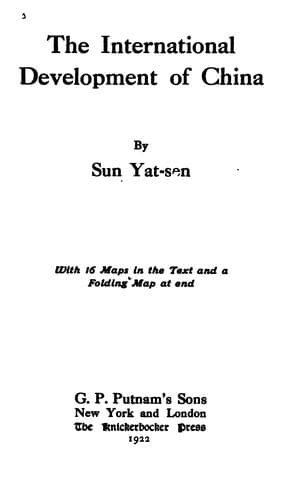
The International Development of ChinaSun, Yat-sen
History
The International Development of China
Sun, Yat-sen
China -- Economic conditions -- 1912-1949; Railroads -- China
In ordinary good years, China never lacks food. There is a common
saying in China that "One year's tilling will provide three years'
wants." In the richer sections of the country, the people generally
reserve three or four years' food supply in order to combat a bad
year. But when China is developed and organized as an economic whole,
one year's food reserve should be kept in the country for the use of
the local people and the surplus should be sent out to the industrial
centers. As the storage and transportation of food will be under a
central management so the distribution and exportation of food should
be under the same charge. All surplus grains of a country district
should be sent to the nearest town for storage and each town or city
should store one year's food. All the staple food should be sold only
at cost price to the inhabitants according to their number, by the
distributing department. And the surplus food should be exported to
foreign countries where it is wanted and where the highest price can be
obtained by the export department under the central management. Thus
the surplus food will not be wasted as hitherto under the prohibition
law. The proceeds of this export will surely amount to a huge sum
which will be used in the payment of the interest and principal of the
foreign loan invested in this undertaking.
We cannot complete this part of the food industry without giving
special consideration to the Tea and Soya industries. The former, as a
beverage, is well known throughout and used by the civilized world and
the latter is just beginning to be realized as an important foodstuff
by the scientists and food administrators. Tea, the most healthy and
delicious beverage of mankind, is produced in China. Its cultivation
and preparation form one of the most important industries of the
country. Once China was the only country that supplied the world with
tea. Now, China's tea trade has been wrested away from her by India
and Japan. But the quality of the Chinese tea is still unequalled.
The Indian tea contains too much tannic acid, and the Japanese tea
lacks the flavor which the Chinese tea possesses. The best tea is only
obtainable in China--the native land of tea. China lost her tea trade
owing to the high cost of its production. The high cost of production
is caused by the inland tax as well as the export duty and by the old
methods of cultivation and preparation. If the tax and duty are done
away with and new methods introduced, China can recover her former
position in this trade easily. In this International Development
Scheme, I suggest that a system of modern factories for the preparation
of tea should be established in all the tea districts, so that the tea
should be prepared by machinery instead of, as hitherto, by hand. Thus
the cost of production can be greatly reduced and the quality improved.
As the world's demand for tea is daily increasing and will be more so
Public-domain text, read in full here on John Shaqi.
Reviews
Reviews
No reviews yet
Be the first to share your thoughts on this work.
Elsewhere in the archive
Join the Discussion
Join the discussion
Sign in to leave a comment or review.
Sign InorCreate an account