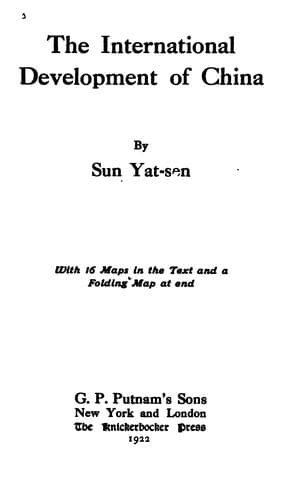
The International Development of ChinaSun, Yat-sen
History
The International Development of China
Sun, Yat-sen
China -- Economic conditions -- 1912-1949; Railroads -- China
However, the tide of the world seems to be turning. After centuries of
sound slumber, the Chinese people at last are waking up and realizing
that we must get up and follow in the world's progress. Now we are at
the parting of the ways. Shall we organize for war or shall we organize
for peace? Our militarists and reactionaries desire the former, and
they are going to Japanize China, so that when the time comes they will
start another Boxer Movement once more to defy the civilized world. But
as the founder of the Chung Hwa Min Kuo--the Chinese Republic--I desire
to have China organized for peace. I, therefore, begin to utilize
my pen, which I hope will prove even mightier than the sword that I
used to destroy the Manchu Dynasty, to write out these programs for
organizing China for peace.
During the course of my writing, these programs have been published
in various magazines and newspapers time after time and are being
spread all over China. They are welcomed everywhere and by everyone
in the country. So far there is not a word expressed in disfavor of
my proposition. The only anxiety ever expressed regarding my scheme
is where can we obtain such huge sums of money to carry out even a
small part of this comprehensive project. Fortunately, however, soon
after the preliminary part of my programs had been sent out to the
different governments and the Peace Conference, a new Consortium was
formed in Paris for the purpose of assisting China in developing her
natural resources. This was initiated by the American Government. Thus
we need not fear the lack of capital to start work in our industrial
development. If the Powers are sincere in their motive to coöperate for
mutual benefit, then the military struggle for material gain in China
could eventually be averted. For by coöperation, they can secure more
benefits and advantages than by struggle. The Japanese militarists
still think that war is the most profitable national pursuit, and
their General Staff keeps on planning a war once in a decade. This
Japanese illusion was encouraged and strengthened by the campaign of
1894 against China, a cheap and short one but rich in remuneration for
Japan; also by the campaign of 1904 against Russia which was a great
success to the Japanese, and its fruit of victory was no less in value;
finally by the campaign of 1914 against Germany which formed her part
in the world war Japan took. Although Japan took the smallest part in
the world war and expended the least in men and money, yet the fruit
of her victory was Shantung, a territory as large as Roumania before
the war, with a population as numerous as that of France. With such
crowning results in every war during the last thirty years no wonder
the Japanese militarists think that the most profitable business in
this world is War.
Public-domain text, read in full here on John Shaqi.
Reviews
Reviews
No reviews yet
Be the first to share your thoughts on this work.
Elsewhere in the archive
Join the Discussion
Join the discussion
Sign in to leave a comment or review.
Sign InorCreate an account