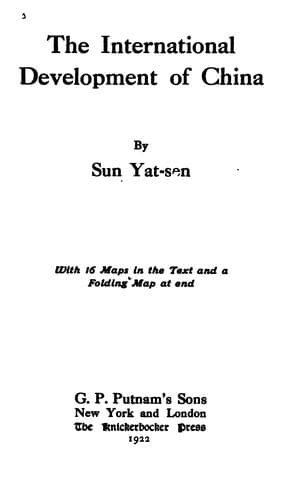
The International Development of ChinaSun, Yat-sen
History
The International Development of China
Sun, Yat-sen
China -- Economic conditions -- 1912-1949; Railroads -- China
The effect of the last war in Europe proves, however, just the
contrary. An aggressive Germany lost entirely her capital and
interests, plus something more, while victorious France gained
practically nothing. Since China is awake now, the next aggression from
Japan will surely be met by a resolute resistance from the Chinese
people. Even granted that Japan could conquer China, it would be an
impossibility for Japan to govern China profitably for any period of
time. The Japanese financiers possess better foresight than their
militarists as was proved during the dispute of the Manchurian and
the Mongolian reservations when the former prevailed over the latter
thus causing the Japanese Government to give up her monopoly of these
territories to the new Consortium, in order to coöperate with the other
powers. We, the Chinese people, who desire to organize China for peace
will welcome heartily this new Consortium provided it will carry out
the principles which are outlined in these programs. Thus, coöperation
of various nations can be secured and the military struggle for
individual and national gain will cease forever.
Commercial war, or competition, is a struggle between the capitalists
themselves. This war has no national distinction. It is fought just
as furiously and mercilessly between countries as well as within
the country. The method of fighting is to undersell each other, in
order to exhaust the weaker rivals so that the victor may control the
market alone and dictate terms to the consuming public as long as
possible. The result of the commercial war is no less harmful and cruel
to the vanquished foes than an armed conflict. This war has become
more and more furious every day since the adoption of machinery for
production. It was once thought by the economists of the Adam Smith
school that competition was a beneficent factor and a sound economic
system, but modern economists discovered that it is a very wasteful
and ruinous system. As a matter of fact, modern economic tendencies
work in a contrary direction, that is, towards concentration instead
of competition. That is the reason why the trusts in America flourish
in spite of the anti-trust law and the public opinion which aim at
suppressing them. For trusts, by eliminating waste and cutting down
expenses can produce much cheaper than individual producers. Whenever
a trust enters into a certain field of industry, it always sweeps that
field clean of rivals, by supplying cheap articles to the public. This
would prove a blessing to the public but for the unfortunate fact that
the trust is a private concern, and its object is to make as much
profit as possible. As soon as all rivals are swept dean from the field
of competition, the trust would raise the price of its articles as
high as possible. Thus the public is oppressed by it. The trust is a
result of economic evolution, therefore it is out of human power to
suppress it. The proper remedy is to have it owned by all the people
Public-domain text, read in full here on John Shaqi.
Reviews
Reviews
No reviews yet
Be the first to share your thoughts on this work.
Elsewhere in the archive
Join the Discussion
Join the discussion
Sign in to leave a comment or review.
Sign InorCreate an account