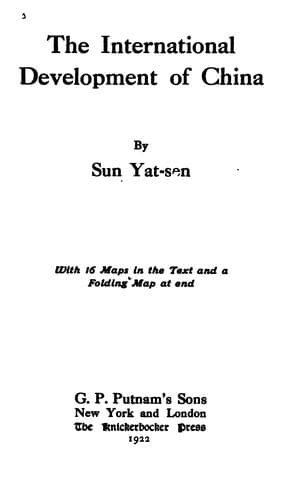
The International Development of China — John Shaqi
The International Development of ChinaSun, Yat-sen
History
The International Development of China
Sun, Yat-sen
China -- Economic conditions -- 1912-1949; Railroads -- China
The Construction of Canals to connect the Inland Waterway Systems of
North and Central China with the Great Northern Port
This scheme will include the regulation of the Hoangho and its
branches, the Weiho in Shensi, and the Fenho in Shansi and connecting
canals. The Hoangho should be deepened at its mouth in order to give a
good drawing to clear its bed of silt and carry the same to the sea.
For this purpose, jetties should be built far out to the deep sea, as
those at the mouths of the Mississippi in America. Its embankments
should be parallel in order to make the width of the channel equal
right along, so as to give equal velocity to the current which will
prevent the deposit of silt at the bottom. By dams and locks, it could
be made navigable right up to Lanchow, in the province of Kansu, and at
the same time water power could be developed. The Weiho and the Fenho
can also be treated in the same manner so as to make them navigable
to a great extent in the provinces of Shensi and Shansi. Thus the
provinces of Kansu, Shensi, and Shansi can be connected by waterway
with our projected port on the Gulf of Pechili, so that cheap carriage
can be provided for the rich mineral and other products from these
three hitherto secluded provinces.
The expenses of regulating the Hoangho may be very great. As a paying
project, it may not be very attractive but as a flood preventive
measure, it is the most important task to the whole nation. This river
has been known as "China's Sorrow" for thousands of years. By its
occasional overflow and bursting of its embankments, millions of lives
and billions of money have been destroyed. It is a constant source of
anxiety in the minds of all China's statesmen from time immemorial.
A permanent safeguard must be effected, once for all, despite the
expenses that will be incurred. The whole nation must bear the burden
of its expenses. To deepen its mouth, to regulate its embankments and
to build extra dykes are only half of the work to prevent flood. The
entire reforestation of its watershed to prevent the washing off of
loess is another half of the work in the prevention of flood.
The Grand Canal, the former Great Waterway of China between the North
and the South for centuries, and now being reconstructed in certain
sections, should be wholly reconstructed from end to end, in order to
restore the inland waterway traffic from the Yangtze Valley to the
North. The reconstruction of this canal will be a great remunerative
concern for it runs right along from Tientsin to Hangchow in an
extremely rich and populous country.
Public-domain text, read in full here on John Shaqi.
Reviews
Reviews
No reviews yet
Be the first to share your thoughts on this work.
Join the Discussion
Join the discussion
Sign in to leave a comment or review.
Sign InorCreate an account