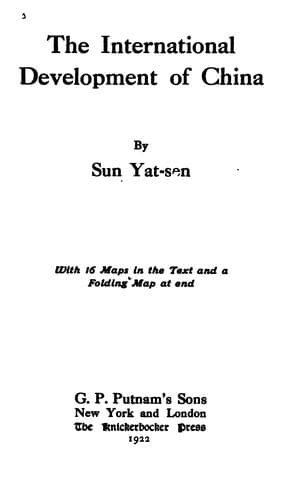
The International Development of ChinaSun, Yat-sen
History
The International Development of China
Sun, Yat-sen
China -- Economic conditions -- 1912-1949; Railroads -- China
As the first principle in our program was remuneration, all our
plans must strictly follow this principle. To create Pootung Point,
therefore, as a civic center and to build a new Bund farther on along
the left bank of the new canal in order to increase the value of the
new land which would result from this scheme must be kept in mind.
Only by so doing would the construction of Shanghai as a deep harbor
be worth while. And only by creating some new and valuable property
in this fore-doomed port could Shanghai be saved from the competition
of our Projected Port. After all, the most important factor for
the salvation of Shanghai is the solution of the silt question of
the Yangtze Estuaries. Now let us see what effect and bearing the
regulating of the Yangtze Channel and Embankments have upon the
question, and this we are going to deal with in the next part.
PART II
The Regulating of the Yangtze River
The regulating of the Yangtze River may be divided as follows:
a. From the deep-water line of the sea to Whangpoo Junction.
b. From Whangpoo Junction to Kiangyin.
c. From Kiangyin to Wuhu.
d. From Wuhu to Tungliu.
e. From Tungliu to Wusueh.
f. From Wusueh to Hankow.
a. Regulating of the Estuary from Deep-water Line Up to the Junction of
Whangpoo
It is a natural law that the obstruction to navigation in all rivers
is begun at their mouths, therefore the improvement of any river
for navigation must start from the estuary. The Yangtze River is no
exception to this rule, therefore to regulate the Yangtze, we must
begin by dealing with its estuaries.
The Yangtze has three estuaries, namely: The North Branch lying between
the left bank and the Island of Tsungming, the North Channel lying
between the Tsungming Island and the Tungsha Banks and the South
Channel lying between the Tungsha Banks and the right bank. Henceforth
for the sake of convenience I shall call them the North, Middle, and
South Channels.
The silting up of a river's mouth is due to the loss of velocity in its
current when the water gets into the wide opening at its junction with
the sea and causes the silt to deposit there. The remedy is to maintain
the velocity of the current by narrowing the mouth of the river so that
it equals that of the upper part. In this way the silt is suspended in
the water moving on into the deep sea. The narrowing process may be
accomplished by walls or training jetties. And thus the silt may be
carried by the water into the deepest part of the open sea and before
it settles down upon the bottom a returning tide will carry it from the
approach into the shallow parts on both sides of the river's mouth. The
mouth of a river can be kept clear from deposit of silt by the action
and reaction of the ebb and flow tide. The conservancy of an estuary of
any river is accomplished by utilizing these natural forces.
Public-domain text, read in full here on John Shaqi.
Reviews
Reviews
No reviews yet
Be the first to share your thoughts on this work.
Join the Discussion
Join the discussion
Sign in to leave a comment or review.
Sign InorCreate an account