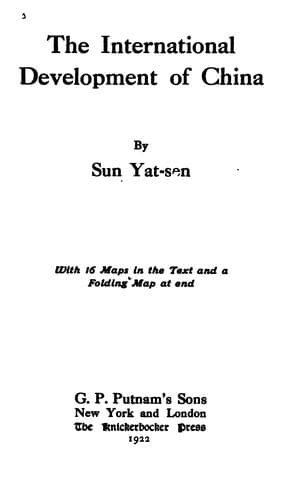
The International Development of ChinaSun, Yat-sen
History
The International Development of China
Sun, Yat-sen
China -- Economic conditions -- 1912-1949; Railroads -- China
China is the land that still employs manual labor for production and
has not yet entered the first stage of industrial evolution, while in
Europe and America the second stage is already reached. So China has
to begin the two stages of industrial evolution at once by adopting
the machinery as well as the nationalization of production. In this
case China will require machinery for her vast agriculture, machinery
for her rich mines, machinery for the building of her innumerable
factories, machinery for her extensive transportation systems and
machinery for all her public utilities. Let us see how this new demand
for machinery will help in the readjustment of war industries. The
workshops that turn out cannon can easily be made to turn out steam
rollers for the construction of roads in China. The workshops that turn
out tanks can be made to turn out trucks for the transportation of the
raw materials that are lying everywhere in China. And all sorts of
warring machinery can be converted into peaceful tools for the general
development of China's latent wealth. The Chinese people will welcome
the development of our country's resources provided that it can be kept
out of Mandarin corruption and ensure the mutual benefit of China and
of the countries coöperating with us.
It might be feared by some people in Europe and America that the
development of China by war machinery, war organization and technical
experts might create unfavorable competition to foreign industries. I,
therefore, propose a scheme to develop a new market in China big enough
both for her own products and for products from foreign countries. The
scheme will be along the following lines:
I. The Development of a Communications System.
(a) 100,000 miles of Railways.
(b) 1,000,000 miles of Macadam Roads.
(c) Improvement of Existing Canals.
(1) Hangchow-Tientsin Canals.
(2) Sikiang-Yangtze Canals.
(d) Construction of New Canals.
(1) Liaoho-Sunghwakiang Canal.
(2) Others to be projected.
(e) River Conservancy.
(1) To regulate the Embankments and Channel of the Yangtze
River from Hankow to the Sea thus facilitating
Ocean-going Ships to reach that port at all seasons.
(2) To regulate the Hoangho Embankments and Channel to
prevent floods.
(3) To regulate the Sikiang.
(4) To regulate the Hwaiho.
(5) To regulate various other rivers.
(f) The Construction of more Telegraph Lines and Telephone and
Wireless Systems all over the Country.
II. The Development of Commercial Harbors.
(a) Three largest Ocean Ports with future capacity equalling
New York Harbor to be constructed in North, Central and
South China.
(b) Various small Commercial and Fishing Harbors to be
constructed along the Coast.
Public-domain text, read in full here on John Shaqi.
Reviews
Reviews
No reviews yet
Be the first to share your thoughts on this work.
Join the Discussion
Join the discussion
Sign in to leave a comment or review.
Sign InorCreate an account