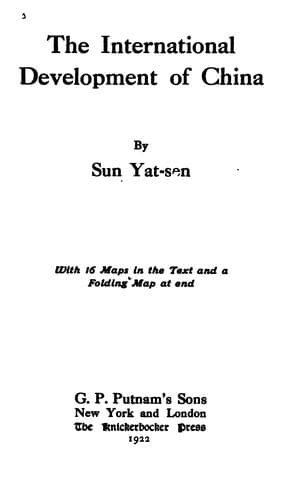
The International Development of ChinaSun, Yat-sen
History
The International Development of China
Sun, Yat-sen
China -- Economic conditions -- 1912-1949; Railroads -- China
To improve the Upper Yangtze from Hankow to Yochow, the work is much
similar to that of the lower part. The channel should be regulated
by rudimental dikes. The concave embankments in sharp bends should
be protected by stone or concrete; obstacles in midstream should be
removed. The great loop, called the Farmer Bend, above Kinkow, should
be cut through at the neck of Paichow, and the sharp point of Hanchin
Kwang should be cut away to make the curve of the river more gentle.
The tortuous part of the Yangtze, north of the Tungting Lake, between
Kinho Kow and Skipper Point, should be blocked up altogether and a
new channel made through Tungting Lake, returning to the Yangtze by
the Yochow Channel. This avoids the crooked passage and shortens the
river course considerably. From Skipper Point to Ichang the dilatations
should be restricted by dikes of stone or piling, and some sharp points
of the shores should be cut away to make the curves more gentle.
The Yangtze River above Ichang enters the Gorges which run about a
hundred miles up to the Szechuen depression, known as the Red Basin.
This part of the river from Ichang right along to its source is
confined by rocky banks, very narrow and deep, having an average depth
of six fathoms and at some particular points even thirty fathoms. Many
rapids and obstructions occur along its course.
To improve the Upper Yangtze, the rapids should be dammed up to form
locks to enable crafts to ascend the river as well as to generate water
power. Obstructions should be blasted and boulders removed. Thus, a
ten-foot channel right along from Hankow to Chungking could be obtained
so that through inland water transportation could be established
from Chungking to Peking in the north and to Canton in the south, as
well as to all navigable points in China Proper all the year round.
In this way, transportation expenses to the richest emporium in West
China could be reduced hundredfold. The benefit to the people will be
enormous and the encouragement to commerce will indeed be great.
PART V
The Establishment of Large Cement Works
Steel and cement are the basis of modern construction, and the most
important factors of the material civilization of the present age. In
the various projects of our development scheme, the demand for steel
and cement will be so enormous that all manufacturing countries
combined will not be able to supply the needs. Therefore, in our first
program, I have proposed to establish large steel works in the rich
iron and coal fields in the provinces of Shansi and Chili; so in this
second program I propose to establish large cement works along the
shores of the Yangtze River. The Yangtze Valley is exceptionally rich
in materials for cement,--limestone and coal lying side by side at the
water edge along the navigable channel from Chinkiang upward. Thus,
local supplies could be created for local needs.
Public-domain text, read in full here on John Shaqi.
Reviews
Reviews
No reviews yet
Be the first to share your thoughts on this work.
Join the Discussion
Join the discussion
Sign in to leave a comment or review.
Sign InorCreate an account