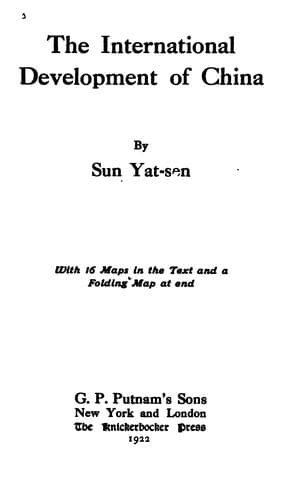
The International Development of China — John Shaqi
The International Development of ChinaSun, Yat-sen
History
The International Development of China
Sun, Yat-sen
China -- Economic conditions -- 1912-1949; Railroads -- China
international development of Canton as a world port in South China.
Canton is situated at the head of the Canton Delta, which is formed by
the junction of three rivers--the Sikiang or West River, the Peikiang
or North River, and the Tungkiang or East River. The area of this
delta is about 3,000 square miles and it has the most fertile alluvial
soil known in China. The land yields three crops a year--two crops of
rice and one crop of other products such as potatoes or beets. In silk
culture, it gives eight crops every year. The most delicious fruits of
many varieties are produced in this delta. This is the most thickly
populated district of all China. Within this delta and its immediate
neighborhood, more than half of the population of Kwangtung province is
found. This is the reason why, despite the great productivity of this
fertile delta, large quantities of foods have to be supplied by the
surrounding country as well as by foreign imports. Before the age of
machinery Canton for centuries was well known as an industrial center
of Eastern Asia. The workmanship and handicraft of its people are still
unequaled in many parts of the world. If machinery will be introduced
in its industries under our international development scheme, Canton
will soon recover its former grandeur as a great manufacturing center.
As a world port, Canton is in a most advantageous position. Being
situated at the junction of three navigable rivers and at the head of
the ocean navigation it is a pivot of inland water as well as ocean
communication in South China. If the Southwestern railway system is
completed, then Canton will be equal in importance to the two great
ports in North and East China, in regard to transportation facilities.
The ocean approach of Canton is generally deep excepting at two points
which can be easily trained and dredged to enable modern liners to
pass in and out at any hour. The deep water line of the ocean reaches
up to Lingting Island, where the depth is from 8 to 10 fathoms. Above
Lingting, the channel gets shallower (about 3 or 4 fathoms) and runs
about 15 miles up to the Fumen Entrance. From this point the water
becomes deep again (between 6 and 10 fathoms) right up to the Second
Bar--a distance of 20 miles. At the Second Bar, the water is about 18
to 20 feet deep for only a few hundred yards. After crossing the Second
Bar, the water becomes deep again for a distance of 10 miles averaging
about 30 feet deep up to the First Bar which will be the city limit of
our future Canton.
Public-domain text, read in full here on John Shaqi.
Reviews
Reviews
No reviews yet
Be the first to share your thoughts on this work.
Join the Discussion
Join the discussion
Sign in to leave a comment or review.
Sign InorCreate an account