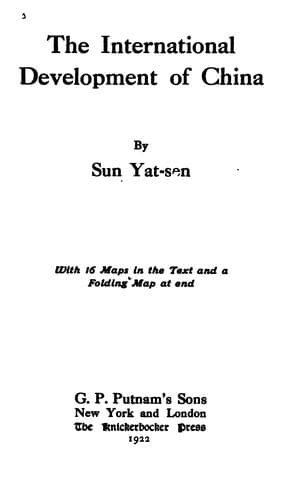
The International Development of ChinaSun, Yat-sen
History
The International Development of China
Sun, Yat-sen
China -- Economic conditions -- 1912-1949; Railroads -- China
This line starts from Sian and runs northward to Sanyuan, Yaochow,
Tungkwan, Yichun, Chungpu, Foochow, Kanchuan, and Yenan, where it
meets the Great Eastern Port-Uliassutai line. From Yenan, it turns
northeastward to Suiteh, Michih, and Kiachow on the right bank of
the Hoangho. Thence it runs along the same bank to the junction of
the Weifen River with the Hoangho (on the opposite side), where it
crosses the Hoangho to the Weifen Valley and proceeds to Singhsien and
Kolan, there crossing the Great Eastern Port-Urga line. From Kolan,
it proceeds to Wuchai and Yangfang, where it crosses the Great Wall
to Sochow and then Tatung there meeting the Peking-Suiyuan line. This
line is about 600 miles long. It passes through the famous oil field in
Shensi, and the northern border of the northwestern Shansi coal field.
At Tatung, where it ends, it joins the Peking-Suiyuan line and through
the section from Tatung to Kalgan it will connect with the future
Northwestern System which will link Kalgan and Dolon Nor together.
g. The Sian-Ninghsia Line
This line will start from Sian in a northwesterly direction to
Kingyanghsien, Shunhwa, and Sanshui. After Sanshui, it crosses the
Shensi border into Kansu at Chengning and then turns west to Ningchow.
From Ningchow, it follows the Hwan Valley along the left bank of the
river up to Kingyangfu and Hwanhsien, where it leaves the bank and
proceeds to Tsingping and Pingyuan, where it meets the Hwan River
again and follows that valley up to the watershed. After crossing
the watershed, it proceeds to Lingchow, then across the Hoangho to
Ninghsia. This line covers a distance of about 400 miles and passes
through a rich mineral and petroleum country.
h. The Sian-Hankow Line
This is a very important line connecting the richest portion of the
Hoangho Valley with the richest portion of the central section of the
Yangtze Valley. It starts from Sian on the track of line (a), crosses
the Tsingling and descends the Tankiang Valley as far as Sichwan. At
this point, it branches off southward across the border into Hupeh, and
following the left bank of the Han River, passes Laohokow to Fencheng,
opposite Siangyang. After Fencheng, it follows continuously the same
bank of the Han River to Anlu, thence proceeding in a direct line
southeastward to Hanchwan and Hankow. This line is about 300 miles long.
i. The Sian-Chungking Line
This line starts from Sian almost directly southward, crosses the
Tsingling Mountain into the Han Valley, passes through Ningshen,
Shihchuan, and Tzeyang, ascends the Jenho Valley across the southern
border of Shensi into the province of Szechwan at Tachuho. Then
crossing the watershed of the Tapashan into the Tapingho Valley, it
follows that valley down to Suiting and Chuhsien. Thence it turns to
the left side of the valley to Linshui and follows the trade road to
Kiangpeh and Chungking. The entire distance of this line is about 450
miles through a very productive region and rich timber land.
Public-domain text, read in full here on John Shaqi.
Reviews
Reviews
No reviews yet
Be the first to share your thoughts on this work.
Elsewhere in the archive
Join the Discussion
Join the discussion
Sign in to leave a comment or review.
Sign InorCreate an account