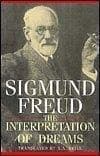
The first book in which the dream is treated as an object of psychology
seems to be that of Aristotle[1] (_Concerning Dreams and their
Interpretation_). Aristotle asserts that the dream is of demoniacal,
though not of divine nature, which indeed contains deep meaning, if it
be correctly interpreted. He was also acquainted with some of the
characteristics of dream life, _e.g._, he knew that the dream turns
slight sensations perceived during sleep into great ones (“one imagines
that one walks through fire and feels hot, if this or that part of the
body becomes slightly warmed”), which led him to conclude that dreams
might easily betray to the physician the first indications of an
incipient change in the body passing unnoticed during the day. I have
been unable to go more deeply into the Aristotelian treatise, because of
insufficient preparation and lack of skilled assistance.
As every one knows, the ancients before Aristotle did not consider the
dream a product of the dreaming mind, but a divine inspiration, and in
ancient times the two antagonistic streams, which one finds throughout
in the estimates of dream life, were already noticeable. They
distinguished between true and valuable dreams, sent to the dreamer to
warn him or to foretell the future, and vain, fraudulent, and empty
dreams, the object of which was to misguide or lead him to
destruction.[E] This pre-scientific conception of the dream among the
ancients was certainly in perfect keeping with their general view of
life, which was wont to project as reality in the outer world that which
possessed reality only within the mind. It, moreover, accounted for the
main impression made upon the waking life by the memory left from the
dream in the morning, for in this memory the dream, as compared with the
rest of the psychic content, seems something strange, coming, as it
were, from another world. It would likewise be wrong to suppose that the
theory of the supernatural origin of dreams lacks followers in our own
day; for leaving out of consideration all bigoted and mystical
authors—who are perfectly justified in adhering to the remnants of the
once extensive realm of the supernatural until they have been swept away
by scientific explanation—one meets even sagacious men averse to
anything adventurous, who go so far as to base their religious belief in
the existence and co-operation of superhuman forces on the
inexplicableness of the dream manifestations (Haffner[32]). The validity
ascribed to the dream life by some schools of philosophy, _e.g._ the
school of Schelling, is a distinct echo of the undisputed divinity of
dreams in antiquity, nor is discussion closed on the subject of the
mantic or prophetic power of dreams. This is due to the fact that the
attempted psychological explanations are too inadequate to overcome the
accumulated material, however strongly all those who devote themselves
to a scientific mode of thought may feel that such assertions should be
repudiated.
Public-domain text, read in full here on John Shaqi.
Reviews
Reviews
No reviews yet
Be the first to share your thoughts on this work.
Join the Discussion
Join the discussion
Sign in to leave a comment or review.
Sign InorCreate an account