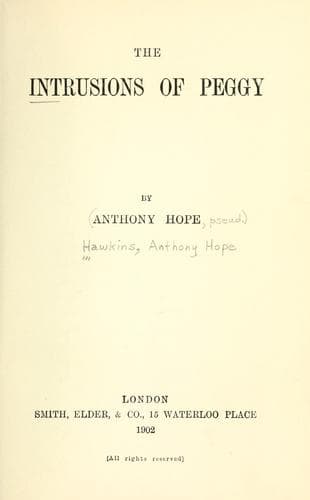
Female friendship -- Fiction; London (England) -- Social life and customs -- Fiction; Widows -- Fiction
'But could the man do anything for her?' asked Trix. 'Something I said
started you on this. The man I thought of would do nothing but make the
bad worse. If she were mean first, he'd make her meaner; if she lied
before, she'd have to lie more; and he'd--he'd break down the last of
her woman's pride.'
'I don't mean a man like that.'
'No, and you're not thinking of a woman like me.'
'She'd have to take the place of the thing that had mastered him; he'd
have to find more delight in her than in it; she'd have to take its
place as the centre of his life.' He was thinking out his problem before
her.
At last Trix was stirred to curiosity. Did any man argue another's case
like this? Was any man roused in this fashion by an abstract discussion?
Or if he were dissuading her from the step she had hinted at, was not
his method perversely roundabout? She looked at him with inquiring eyes.
In answer he came across the room to her.
'Yet, if there were a man and a woman such as we've been speaking of,
and there was half the shadow of a chance, oughtn't they to clutch at
it? Oughtn't they to play the bold game? Ought they to give it up?'
His excitement was unmistakable now. Again he looked in her eyes as he
had once before. She could do nothing but look up at him, expecting what
he would say next. But he drew back from her, seeming to repent of what
he had said, or to retreat from its natural meaning. He wandered back to
the hearthrug, and fingered the statement of her position that lay on
the mantelpiece. He was frowning and smiling too; he looked very
puzzled, very kindly, almost amused.
'Wouldn't they be fools not to have a shot?' he asked presently. 'Only
she ought to know the truth first, and he'd find it deuced hard to tell
her.'
'She would have found it very hard to tell him.'
'But she would have?'
'Yes--if she loved him,' said Trix, smiling. 'Confession and humiliation
comfort women when they're in love. When they're not----' She shuddered.
Presumably Barslett came into her mind.
'If he never told her at all, would that be fair?'
'She couldn't forgive that, if she found it out.'
'No?'
'Well, it would be very difficult.'
'But if she never found it out?'
'That would be the grandest triumph of all for her, perhaps,' said Trix
very softly. For now, vague, undefined, ignorant still, but yet sure at
its mark, had come the idea that somehow, for some reason, Airey Newton
spoke not of Beaufort Chance, nor of another, not of some abstraction
or some hypothetical man, but of his very self. 'My prayer to him would
be not to tell me, and that I might never know on earth. If I knew ever,
anywhere, then I should know too what God had let me do.'
'But if he never told you, and some day you found out?'
Trix looked across at him--at his dreary smile and his knitted brow. She
amended the judgment she had given a minute before: 'We could cry
together, or laugh together, or something, couldn't we?' she asked.
Public-domain text, read in full here on John Shaqi.
Reviews
Reviews
No reviews yet
Be the first to share your thoughts on this work.
Elsewhere in the archive
Join the Discussion
Join the discussion
Sign in to leave a comment or review.
Sign InorCreate an account