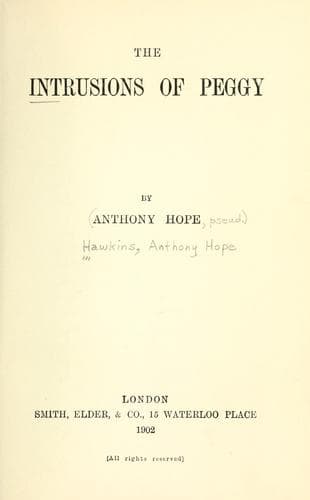
Female friendship -- Fiction; London (England) -- Social life and customs -- Fiction; Widows -- Fiction
'Yes, one you know--to Tommy.' He nodded. 'The other to her--I promised
to tell no one she was ruined. But that's not much. It seems to me as if
all that she's gone through, all she's lost, all she's suffered--yes,
if you like, all the wrong things she's done--had somehow all been for
you. She was the only woman who could have made the change in you.
Nobody else could have driven out the idol, Airey. You talk of me.
You've known me for years. Did I ever drive it out? No, she had to do
it. And before she could, she had to be ruined, she had to be in the
dust--perhaps she had to be cruel or unjust to others. I can't work out
the philosophy of it, but that's how it's happened.' She paused, only to
break out vehemently again: 'You spoil it with your talk of me; you
spoil it with the necklace!' With a sudden movement she raised her
hands, unclasped the pearls from about her neck, and threw them on the
table. 'Everything for her, Airey,' she begged, 'everything for her!'
His eyes followed the pearls, and he smiled. 'But what about all the
things for me?'
'Aren't they for her too? Aren't you for her? Wouldn't you go to her as
fine as you could?'
'What a woman--what a very woman you are!' he chuckled softly.
'No, that's all right,' she insisted eagerly. 'Would she be happy if you
lavished things on her and were still wretched if you had anything for
yourself?' She was full of her subject; she sprang up and faced him.
'Not this time to the poor, because they can't repay! Not this time to
the fire, because it would give you no profit! You must love this--it's
a great investment!'
He sat down in the chair she had left empty and played with the pearls
that lay on the table.
'Yes, you're right,' he said at last. 'She was the beginning of it. It
was she who--but shall I tell that to her?'
'Yes, tell it to her, to her only,' urged Peggy Ryle.
'Give me your hands, Peggy. I want to tell something to you.'
'No, no, there's nothing to tell me--nothing!'
'If the philosophy is great and true, is there to be no credit for the
teacher?'
'Did I?' murmured Peggy, 'did I?' She went on in a hurried whisper: 'If
that's at all true, perhaps Tommy Trent will forgive me for breaking my
word.'
'If Fricker fell, and I have fallen, who is Tommy Trent?'
She moved away with a laugh, hunted for a cigarette--the box was hidden
by papers--found it, and lit it. She saw Airey take up the pearls, go to
the safe, open it, and lock them in.
'Never!' she cried in gay but determined protest.
'Yes, some day,' said he quietly, as he went back to his seat.
They sat together in silence till Peggy had finished her cigarette and
thrown it away.
'If all goes well,' he said softly, more as though he spoke to himself
than to her, 'I shall have something to work for now. I can fancy work
will be very pleasant now, if things go well, Peggy.'
She rose and crossed over to him.
'I must run away,' she said softly. She leant down towards him. 'Is it a
great change?' she asked.
Public-domain text, read in full here on John Shaqi.
Reviews
Reviews
No reviews yet
Be the first to share your thoughts on this work.
Elsewhere in the archive
Join the Discussion
Join the discussion
Sign in to leave a comment or review.
Sign InorCreate an account