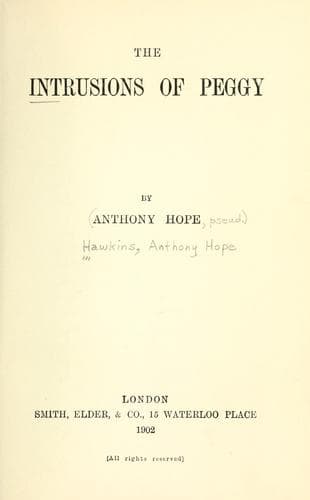
Female friendship -- Fiction; London (England) -- Social life and customs -- Fiction; Widows -- Fiction
'Tremendous--as tremendous as its philosophy.' He was serious under the
banter. She was encouraged to her last venture, which he might have
laughed back into retreat.
'It isn't really any change to me,' she told him in a voice that
trembled a little. 'You've always been all right to me. This has always
been a refuge and a hospitable home to me. If it had all failed, I
should have loved you still, Airey, my friend.'
Airey was silent again for an instant.
'Thank God, I think I can believe you in that,' he said at last.
She waited a moment longer, caressing his hand gently.
'And you'll go soon?' she whispered. 'You'll go to her soon?'
'This very night, my dear,' said Airey Newton.
Peggy stood upright. Again the sun's rays caught her eyes and hair, and
flashed on her hands as she stretched them out in an ample luxury of
joy.
'Oh, what a world it is, if you treat it properly, Airey!' she cried.
But she also had made her discovery. It was with plain amusement and a
little laugh, still half-incredulous, that she added: 'And after all
there may be some good in saving money too!'
CHAPTER XXIII
THE LAST KICK
It was no wonder that Trix Trevalla was holding up her head again. Her
neck was freed from a triple load. Mervyn was gone, and gone, she had
warrant for believing, if not in contentment, yet in some degree of
charity. Beaufort Chance, that terror of hers, whose coarse rebukes made
justice seem base cruelty, was gone too--and Trix was still unregenerate
enough not to care a jot with what feelings. His fate seemed so
exquisitely appropriate to him as to exclude penitence in her. Lastly,
Fricker was gone, and with him the damning sense of folly, of being a
silly dupe, which had weighed more sorely than anything else on a spirit
full of pride. Never a doubt had she about Fricker's letter. He had
indeed been honourable in his dealing with Peggy Ryle; he had left Trix
to think that in surrendering the shares to him she fell in with a
business proposal which he was interested in making, and that she gave
at least as good as she received. It needed very little more to make her
believe that she was conferring a favour on him, and thereby cancelling
the last item of the score that he once had against her. Surely, then,
Peggy was both wise and merciful in arguing that she should not know the
truth, but should still think that she was in debt to no man for her
emancipation.
Public-domain text, read in full here on John Shaqi.
Reviews
Reviews
No reviews yet
Be the first to share your thoughts on this work.
Elsewhere in the archive
Join the Discussion
Join the discussion
Sign in to leave a comment or review.
Sign InorCreate an account