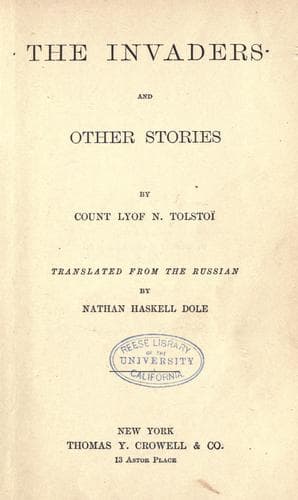
Russian fiction -- Translations into English; Short stories, Russian -- Translations into English
"As you may please to order, madame. But it would be too bad to send
any of the Dutlofs. They are all, without exception, good boys; but if
you don't take one of the house-servants[1] you will have to send one
of them without fail," said the overseer; "and now all point to them.
However, as you wish."
And he placed his right hand on his left, holding them both over his
stomach, tipped his head on one side, sucked in his thin lips, almost
smacking them, turned away his eyes, and held his peace, with the
evident intention of holding it long, and of listening without reply
to all the nonsense which the mistress might say to him in this regard.
The overseer had formerly been one of the household servants, and now,
this autumn evening, he was holding conference with his mistress, and
was standing before her, clean-shaven, in his long coat, the special
dress of the overseer. The conference as the mistress understood it was
to be devoted to reckoning the profits and losses of the past season,
and in making arrangements for the one to come. As Yégor Mikhaïlovitch
the overseer understood it, the conference consisted of the rite of
standing in a corner firmly on his two feet, set wide apart, with his
face turned to the sofa, listening to all the good lady's unending and
aimless babble, and leading her by various expedients to the point of
saying hastily and impatiently, "Very good, very good," to all his
suggestions.
The point at issue just at present was the conscription. Three soldiers
had to be sent from Pokrovskoé. Two were unquestionably named by
Providence itself, with a due regard for family, moral, and economical
conditions. Concerning them there could be neither hesitation nor
quarrel on the part of the Commune,[2] or the lady of the manor, or the
people in general.
The third was harder to decide upon. The overseer wanted to avoid
sending any of the three Dutlofs, and proposed Polikushka, a servant
who had a family and a very bad reputation, having more than once
been convicted of stealing corn, reins, and hay; but the mistress,
who had often caressed Polikushka's ragged children, and by means of
evangelical teachings had improved his morals, did not wish to let him
go. At the same time she had no ill-will against the Dutlofs, whom
she did not know and had never seen. And so she could not come to any
decision at all, and the overseer hadn't the courage to explain to her
explicitly that if Polikushka did not go Dutlof would have to go.
"Well, I don't wish to cause the Dutlofs any unhappiness," she said
with feeling.
"If you don't want them to go, then pay three hundred rubles for a
substitute," was the reply that he should have made her; but his
diplomacy was not equal to such an emergency.
Public-domain text, read in full here on John Shaqi.
Reviews
Reviews
No reviews yet
Be the first to share your thoughts on this work.
Elsewhere in the archive
Join the Discussion
Join the discussion
Sign in to leave a comment or review.
Sign InorCreate an account