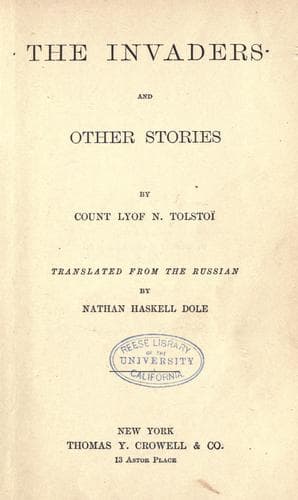
Russian fiction -- Translations into English; Short stories, Russian -- Translations into English
There were many different characters in this group of peasants: some
were morose, some courteous, some indifferent, some disputatious;
there were also a few women behind the muzhíks, with sticks. But
about all these I will tell some other time, as God shall give. The
throng consisted, for the most part, however, of muzhíks, who behaved
during the meeting as though it were church, and standing in the rear
talked in a whisper about their domestic affairs, exchanging views,
for instance, about the best time for beginning to cut their wood, or
quietly hoped that they soon adjourn the meeting. And then there were
some well-to-do men, whose comfort the meeting could not benefit or
curtail. To this number belonged Yermil, with his broad, shiny face,
whom the muzhíks called "big-belly" because he was rich. To this number
also belonged Starostin, on whose face a self-satisfied expression of
power was habitual: "Say whatever you please among yourselves, but I
am safe enough. I have four sons, but you won't take any of them."
Occasionally, the opinionated young orators, like Kopilof or Rézun,
would have a fling at them; and they would reply, but calmly and
decidedly in the consciousness of their unassailable position.
However much Dutlof was like the old hen in the game of "Hawk," it
could not be said that his lads were like the chickens. They did not
hop about nor scream, but stood calmly behind him. The oldest, Ignat,
was now thirty years old; the second, Vasíli, was already married, but
was not old enough to come under the conscription; the third, Ilyushka,
the nephew who had just been married, had a red and white complexion,
and was dressed in an elegant sheepskin coat (he was a driver[7] by
profession); he stood gazing at the people, occasionally scratching the
back of his head under the cap, as though the affair did not concern
him at all any more than if it were the game of "Hawk."
"Because my grandfather went as a soldier," Rézun was saying, "that's
no reason why I should refuse the lot. Friends, it is no kind of a law
at all. At the last conscription they took Mikhéichef, and his uncle is
still in the service."
"Neither your father nor your uncle ever served the Tsar both at once,"
said Dutlof, "and you never served gentlemen nor the Commune; but
you've always been a tippler, and your children take after you. It's
impossible to live with you, and yet you point out other men. But for
ten years I have been police-commissioner,[8] and I have been elder,
and twice I have been burnt out, and no one ever helped me; and is it
because we live peaceably at our place, ay and honorably, that I am to
be ruined? Give me back my brother. He died there, didn't he? Judge
right, judge according to God's law, O orthodox Commune! and do not
listen to the lies of that drunkard."
At this instant Gerásim said to Dutlof,--
Public-domain text, read in full here on John Shaqi.
Reviews
Reviews
No reviews yet
Be the first to share your thoughts on this work.
Elsewhere in the archive
Join the Discussion
Join the discussion
Sign in to leave a comment or review.
Sign InorCreate an account