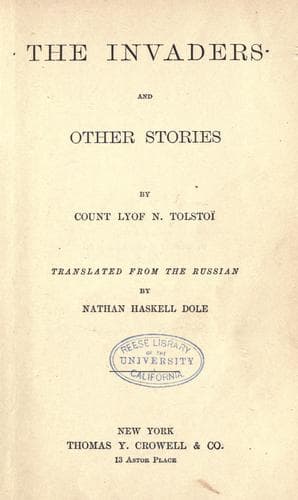
Russian fiction -- Translations into English; Short stories, Russian -- Translations into English
There were four families, besides Dutlofs, that had three able-bodied
men. But one was the village elder's, and his mistress had freed him
from service. From another family, a recruit had been taken at the last
conscription. From the other two families, two men had been already
nominated, and one of them had not come to the meeting; but his wife
stood, heavy at heart, in the very rear, anxiously hoping that somehow
the wheel would turn in favor of her happiness. The other of the two
nominees, the red-haired Román, in a torn cloak (though he was not
poor), stood leaning against the door-step, with downcast head; he said
nothing all the while, but occasionally looked up attentively when any
one spoke louder than usual, and then dropped his head again; and thus
his unhappiness was expressed in his whole appearance. The old man,
Sem'yón Dutlof, would have given the impression, even to these who knew
him slightly, that he had laid up hundreds and thousands of rubles. He
was dignified, God-fearing, substantial; he was, moreover, an elder of
the Church. So much the more striking was the chance in which he found
himself.
Rézun the carpenter was, on the contrary, a tall, dark, dissipated
man, quick to quarrel, and fond of speaking in meetings and in the
market-place, with workmen, merchants, muzhíks, or gentlemen. Now he
was calm and sarcastic, and with all the advantage of his stature, all
the force of his loud voice, and his oratorical talent, was nagging the
elder of the church, who was such a slip-shod speaker, and had been
driven far out of his path.
The others who took part in the discussion were as follows: The
round-faced, young-looking Garaska Kopilof, stocky, with a four-square
head, and curly beard; one of the speakers who imitated Rézun rather
than the younger generation, always distinguished for his bitter
speech, and already a man of weight in the meeting. Then Féodor
Melnitchnui, a tall, yellow, gaunt, round-shouldered muzhík, also
young, with thin hair and beard, and with small eyes; always prone to
anger, sour-tempered, ready to see every one's bad side, and frequently
embarrassing the meeting with his abrupt and unexpected questions and
remarks. Both of these speakers were on Rézun's side. Moreover, two
chatterers occasionally took part,--one who had a good-natured phiz,
and a large and bushy red beard; his name was Khrapkof, and he was
forever saying, "My dearly beloved friend:" and the other, Zhidkof, a
small man, with a bird-like face, who was also in the habit of saying,
"It follows, my brethren;" he kept turning to all sides, and his words
were without rhyme or reason. One of these two took one side, the
other the other; but no one heeded what they said. There were others
like them; but these two kept moving in and out in the crowd, shouted
more than anybody else, disturbing the mistress, were listened to less
than anybody else, and, being confused by the racket and shouting,
found full satisfaction in talking nonsense.
Public-domain text, read in full here on John Shaqi.
Reviews
Reviews
No reviews yet
Be the first to share your thoughts on this work.
Elsewhere in the archive
Join the Discussion
Join the discussion
Sign in to leave a comment or review.
Sign InorCreate an account