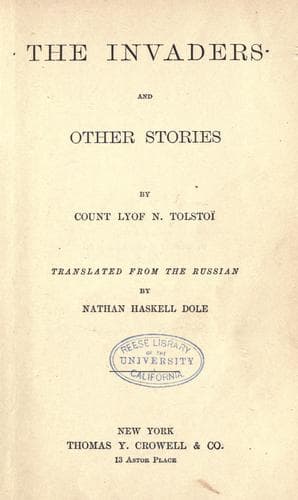
Russian fiction -- Translations into English; Short stories, Russian -- Translations into English
"_Yok_ (no)," he replied, shaking his head as a sign of negation,
"Shamyl will not march out. Shamyl will send his _naïbs_[24] and he
himself will look down from up yonder through his glass."
"But doesn't he live a long way off?"
"Not a long way off. Here, at your left, about ten _versts_ he will be."
"How do you know that?" I inquired. "Have you been there?"
"I've been there. All of us in the mountains have."
"And you have seen Shamyl?"
"_Pikh!_ Shamyl is not to be seen by us. A hundred, three hundred, a
thousand _murids_[25] surround him. Shamyl will be in the midst of
them," he said with an expression of fawning servility.
Looking up in the air, it was possible to make out that the sky which
had become clear again was lighter in the east, and the Pleiades were
sinking down into the horizon. But in the gulch through which we were
passing, it was humid and dark.
Suddenly, a little in advance of us, from out the darkness flashed a
number of lights; at the same instant, with a ping some bullets whizzed
by, and from out the silence that surrounded us from afar arose the
heavy, overmastering roar of the guns. This was the vanguard of the
enemy's pickets. The Tatars, of which it was composed, set up their
war-cry, shot at random, and fled in all directions.
Every thing became silent again. The general summoned his interpreter.
The Tatar in a white Circassian dress hastened up to him, and the two
held a rather long conversation in a sort of whisper and with many
gestures.
"Colonel Khasánof! give orders to scatter the enemy," said the general
in a low, deliberate, but distinct tone of voice.
The division went down to the river. The black mountains stood back
from the pass; it was beginning to grow light. The arch of heaven,
in which the pale, lustreless stars were barely visible, seemed to
come closer; the dawn began to glow brightly in the east; a cool,
penetrating breeze sprang up from the west, and a bright mist like
steam arose from the foaming river.
[Footnote 19: _topot._]
[Footnote 20: In the Caucasus the freshets take place in the mouth of
July.]
[Footnote 21: _tayak_ in the Caucasian dialect.]
[Footnote 22: _tomásha_ means slaves in the ordinary dialect invented
for intercourse between Russians and Tatars. There are many words in
this strange dialect, the roots of which are not to be found either in
Russian or Tatar.--AUTHOR'S NOTE.]
[Footnote 23: Goods and chattels in the same dialect.]
[Footnote 24: _naïb_ ordinarily means a Mohammedan judge or high
religious officer, in Turkey and the Caucasus; hero it means an officer
whom the great Circassian chieftain Shamyl endowed with special
authority.]
[Footnote 25: The word _murid_ has many significations, but in
the sense here employed it means something between adjutant and
body-guard.--AUTHOR'S NOTE.]
VIII.
Public-domain text, read in full here on John Shaqi.
Reviews
Reviews
No reviews yet
Be the first to share your thoughts on this work.
Join the Discussion
Join the discussion
Sign in to leave a comment or review.
Sign InorCreate an account