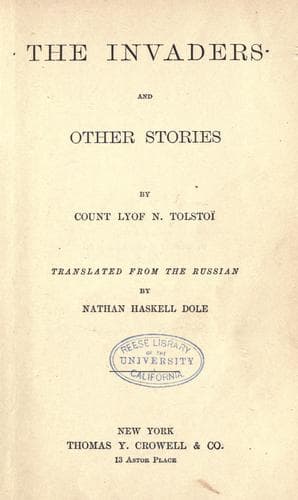
Russian fiction -- Translations into English; Short stories, Russian -- Translations into English
"Oh, bring him back! I want to ask him how he found it. Bring him in
here. I can't go out to him."
Duniasha flew out, and overtook the muzhík in the hall. He had not put
on his hat, but had taken out his purse, and bending over was opening
it; but the money he held between his teeth. Maybe it seemed to him
that it was not his until he had put it in his purse. When Duniasha
called him back, he was startled.
"What ... Avdót'ya?... Avdót'ya Mikolavna? Is she going to take it
away from me? If you would only take my part, I would bring you some
honey,--before God I would."
"All right, bring it,'"
Again the door opened, and the muzhík was led into the mistress's
presence. It was not a happy moment for him. "Akh! she's going to take
it back!" he said to himself, as he went through the rooms, lifting
his feet very high, as though walking through tall grass, so as not to
make a noise with his big wooden shoes. He did not comprehend, and he
scarcely noticed what was around him. He passed by the mirror; he saw
some flowers, some muzhík or other lifting up his feet shod in sabots,
the bárin painted with one eye and something that seemed to him like
a green tub, and a white object.... Suddenly, from the white object
issued a voice. It was the mistress. He could not distinguish any one
clearly, but he rolled his eyes around. He knew not where he was, and
every thing seemed to be in a mist.
"Is it you, Dutlof?"
"It's me, your ladyship.[28] It's just as it was. I didn't touch it,"
he said. "I wasn't glad,--before God, I wasn't. I almost killed my
horse."
"It's your good luck," she said with a perfectly sweet smile. "Keep it,
keep it. It's yours."
He only opened wide his eyes.
"I am glad that you have it. God grant that it prove useful to you. Are
you glad to have it?"
"How could I help being glad? Glad as I can be, mátushka! I will always
pray to God for you. I am as glad as I can be, that, glory to God, our
mistress is alive. Only it was my fault."
"How did you find it?"
"You know that we can always work for our lady for honor's sake, and,
if not that" ...
"He's getting all mixed up, my lady said," Duniasha.
"I carried my nephew, who's gone as a _n_ecruit, and on my way back I
found it on the road. Polikéï must have dropped it accidentally."
"Well, now go, now go! I am glad."
"So am I glad, mátushka," said the muzhík.
Then he recollected that he had not thanked her, but he did not know
how to go about it in the proper manner. The lady and Duniasha both
smiled, as he again started to walk, as though through tall grass, and
by main force conquered his impulse to break into a run. But all the
time it seemed to him that they were going to hold him, and take it
from him.
[Footnote 23: The son of Nahum. It is customary among the peasantry to
call each other by the patronymic. Thus Polikéï is generally called
Ilyitch, son of Ilya, instead of the more formal Polikéï Ilyitch.]
[Footnote 24: _Akh Bozhe moï._]
[Footnote 25: _sudárinya._]
Public-domain text, read in full here on John Shaqi.
Reviews
Reviews
No reviews yet
Be the first to share your thoughts on this work.
Elsewhere in the archive
Join the Discussion
Join the discussion
Sign in to leave a comment or review.
Sign InorCreate an account