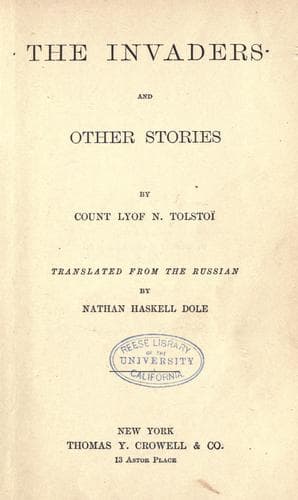
Russian fiction -- Translations into English; Short stories, Russian -- Translations into English
"Don't commit a sin," said Dutlof, pressing the money upon him. "We
must all die," he went on in such a short, didactic, and confident
voice that the master said, "There's nothing to be done," once more
shook hands, and began to say a prayer. "With God's blessing," he said.
They awoke the substitute, who was still sleeping off his yesterday's
spree; they inspected him, and then all went to the authorities. The
substitute was hilarious, asked to be refreshed with some rum, for
which Dutlof gave him money, and began to feel scared only at the
moment when they first entered the vestibule of the court-house. They
stood long in the vestibule: the old master[42] in a blue overcoat,
and the substitute in a short sheepskin, with lifted eyebrows and
wide-staring eyes; long they stood there whispering together, asked
questions of this man and that, were sent from pillar to post, took off
their hats and bowed before every petty clerk, and solemnly listened to
the speech made by a clerk whom the master knew. All hope of finishing
the business that day was vanishing, and the substitute was already
beginning to feel more cheerful and easy, when Dutlof caught sight of
Yégor Mikhailovitch, immediately went to him, and began to beseech him,
and make low bows. The overseer's influence was so powerful, that by
three o'clock the substitute, much to his disgust and surprise, was
conducted into the audience-chamber, enrolled on the army list, and
to the satisfaction of every one, from door-tender to president, was
stripped, shaved, dressed in uniform, and sent out to camp. And at
the end of five minutes Dutlof had paid the money over, and taken his
receipt; and after saying good-by to the recruit and his master, he
went to the merchant's lodging-house where the recruits from Pokrovskoé
were stopping.
His nephew and the wife were sitting in one corner of the merchant's
kitchen; and when the old man came in, they ceased talking, and behaved
toward him in a humble and yet hostile manner.
"Don't be vexed, Ilyúkha," he said, approaching his nephew. "Day before
yesterday you said a harsh word to me. Am I not sorry for you? I
remember how my brother commended you to my care. If it had been in my
power, would I have let you go? God granted me a piece of good fortune:
you see I have not been mean. Here is this paper," said he, laying the
receipt on the table, and carefully smoothing it out with his crooked,
stiffened fingers.
All of the Prokrovski muzhíks, and the merchant's people, and also some
of the neighbors, came into the inn.[43] All watched inquisitively what
was going on. No one interrupted the old man's triumphal words.
"Here's the paper. I paid nearly four hundred silver rubles for it.
Don't blame your uncle!"
Public-domain text, read in full here on John Shaqi.
Reviews
Reviews
No reviews yet
Be the first to share your thoughts on this work.
Elsewhere in the archive
Join the Discussion
Join the discussion
Sign in to leave a comment or review.
Sign InorCreate an account