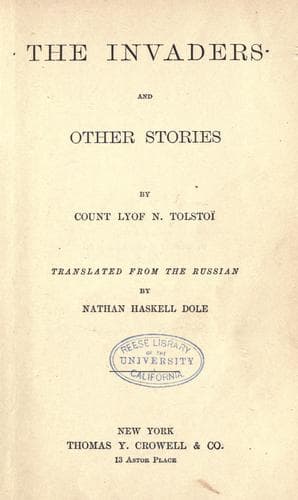
Russian fiction -- Translations into English; Short stories, Russian -- Translations into English
Not paying any heed to the antics played around him by the young
fillies, the colts, and the yearlings, and knowing that the health of
everybody, and especially one who had attained his years, was subserved
by getting a good drink of water on an empty stomach, and then eating,
he turned his steps to where the bank was less steep and slippery; and
wetting his hoofs and gambrels, he thrust his snout into the river,
and began to suck the water through his lips drawn back, to puff with
his distending sides, and out of pure satisfaction to switch his thin,
piebald tail with its leathery stump.
A chestnut filly, always mischievous, always nagging the old horse, and
causing him manifold unpleasantnesses, came down to the water as though
for her own necessities, but really merely for the sake of roiling the
water in front of his nose.
But the gelding had already drunk enough, and apparently giving no
thought to the impudent mare, calmly put one miry leg before the other,
shook his head, and, turning aside from the wanton youngster, began
to eat. Dragging his legs in a peculiar manner, and not tramping down
the abundant grass, the horse grazed for nearly three hours, scarcely
stirring from the spot. Having eaten so much that his belly hung down
like a bag from his thin, sharp ribs, he stood solidly on his four weak
legs, so that as little strain as possible might come on any one of
them,--at least on the right foreleg, which was weaker than all,--and
went to sleep.
There is an honorable old age, there is a miserable old age, there is a
pitiable old age; there is also an old age that is both honorable and
miserable. The old age which the piebald gelding had reached was of
this latter sort.
The old horse was of a great size,--more than seventeen hands high.[4]
His color was white, spotted with black; at least, it used to be so,
but now the black spots had changed to a dirty brown. The regions of
black spots were three in number: one on the head, including the mane,
and side of the nose, the star on the forehead, and half of the neck;
the long mane, tangled with burrs, was striped white and brownish; the
second spotted place ran along the right side, and covered half the
belly; the third was on the flank, including the upper part of the tail
and half of the loins; the rest of the tail was whitish, variegated.
Public-domain text, read in full here on John Shaqi.
Reviews
Reviews
No reviews yet
Be the first to share your thoughts on this work.
Elsewhere in the archive
Join the Discussion
Join the discussion
Sign in to leave a comment or review.
Sign InorCreate an account