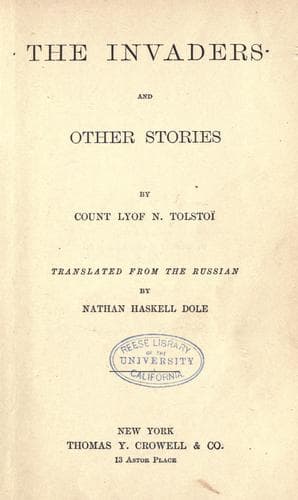
Russian fiction -- Translations into English; Short stories, Russian -- Translations into English
"He austerely flung the hay behind the grating. I laid my head over his
shoulder; but he struck me such a hard blow with his fist on the nose,
that I started back. Then he kicked me in the belly with his boot.
"'If it hadn't been for this scurvy beast,' said he, 'there wouldn't
have been any trouble.'
"'Why?' asked another groom.
"'He doesn't come to inquire about the count's you bet! But twice a day
he comes out to look after his own.'
"'Have they given him the piebald?' inquired another.
"'Whether they've given it to him or sold it to him, the dog only
knows! The count's might die o' starvation--it wouldn't make any
difference; but see how it upset him when I didn't give _his_ horse
his fodder! 'Go to bed,' says he, 'and then you'll get a basting.' No
Christianity in it. More pity on the cattle than on a man. I don't
believe he's ever been christened, he himself counted the blows, the
barbarian! The general did not use the whip so. He made my back all
welts. There's no soul of a Christian in him!'
"Now, what they said about whips and Christianity, I understood well
enough; but it was perfectly dark to me as to the meaning of the words,
_my horse, his horse,_ by which I perceived that men understood some
sort of bond between me and the groom. Wherein consisted this bond, I
could not then understand at all. Only long after, when I was separated
from the other horses, I came to learn what it meant. At that time I
could not understand at all that it meant that they considered _me_ the
property of a man. To say _my horse_ in reference to me, a live horse,
seemed to me as strange as to say, _my earth, my atmosphere, my water._
"But these words had a monstrous influence upon me. I pondered upon
them ceaselessly; and only after long and varied relations with men
did I come at last to comprehend the meaning that men find in these
strange words.
"The meaning is this: Men rule in life, not by deeds, but by words.
They love not so much the possibility of doing or not doing any thing,
as the possibility of talking about different objects in words agreed
upon between them. Such words, considered very important among them,
are the words, _my, mine, ours,_ which they employ for various things,
beings, and objects; even for the earth, people, and horses. In regard
to any particular thing, they agree that only one person shall say 'It
is _mine._' And he who in this play, which they engage in, can say
_mine_ in regard to the greatest number of things, is considered the
most fortunate among them. Why this is so, I know not; but it is so.
Long before, I had tried to explain this to my satisfaction, by some
direct advantage; but it seemed that I was wrong.
Public-domain text, read in full here on John Shaqi.
Reviews
Reviews
No reviews yet
Be the first to share your thoughts on this work.
Elsewhere in the archive
Join the Discussion
Join the discussion
Sign in to leave a comment or review.
Sign InorCreate an account