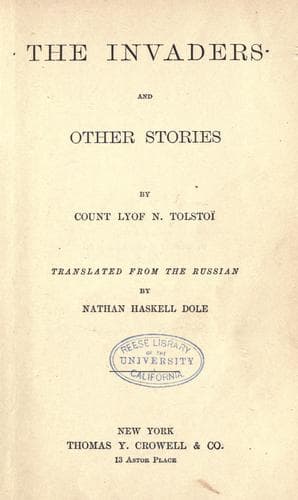
Russian fiction -- Translations into English; Short stories, Russian -- Translations into English
"Many of the men who, for instance, called me their horse, did not ride
on me, but entirely different men rode on me. They themselves did not
feed me, but entirely different people fed me. Again, it was not those
who called me their horse who treated me kindly, but the coachman, the
veterinary, and, as a general thing, outside men.
"Afterwards, as I widened the sphere of my experiences, I became
convinced that the concept _my,_ as applied not only to us horses,
but to other things, has no other foundation than a low and animal, a
human instinct, which they call the sentiment or right of property.
Man says, _my house,_ and never lives in it, but is only cumbered with
the building and maintenance of it. The merchant says, _my shop_,--my
clothing-shop, for example,--and he does not even wear clothes made of
the best cloth in the shop.
"There are people who call land theirs, and have never seen their land,
and have never been on it. There are men who call other people theirs,
but have never seen these people; and the whole relationship of these
owners, to these people, consists in doing them harm.
"There are men who call women theirs,--their wives or mistresses; but
these women live with other men. And men struggle in life not to do
what they consider good, but to be possessors of what they call their
own.
"I am convinced now that herein lies the substantial difference between
men and us. And, therefore, not speaking of other things, where we are
superior to men, we are able boldly to say that in this one respect at
least, we stand, in the scale of living beings, higher than men. The
activity of men--at all events, of those with whom I have had to do--is
guided by words; ours, by deeds.
"And here the head groom obtained this right to say about me, _my
horse;_ and hence he lashed the hostler. This discovery deeply
disturbed me; and those thoughts and opinions which my variegated coat
aroused in men, and the thoughtfulness aroused in me by the change
in my mother, together subserved to make me into that solemn and
contemplative gelding that I am.
"I was threefold unhappy: I was piebald; I was a gelding; and men
imagined that I did not belong to God and myself, as is the prerogative
of every living thing, but that I belonged to the equerry.
"The consequences of their imagining this about me were many. The first
was, that they kept me apart from the others, fed me better, led me
more often, and harnessed me up earlier. They harnessed me first when
I was in my third year. I remember the first time, the equerry himself,
who imagined that I was his, began, with a crowd of grooms, to harness
me, expecting from me some ebullition of temper or contrariness. They
put leather straps on me, and conducted me into the stalls. They laid
on my back a wide leather cross, and attached it to the thills, so that
I should not kick; but I was only waiting an opportunity to show my
gait, and my love for work.
Public-domain text, read in full here on John Shaqi.
Reviews
Reviews
No reviews yet
Be the first to share your thoughts on this work.
Elsewhere in the archive
Join the Discussion
Join the discussion
Sign in to leave a comment or review.
Sign InorCreate an account