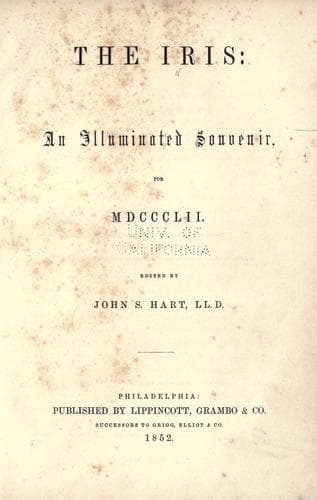
Gift books; Indians of North America -- Literary collections
At last her husband brought home another wife, and she was forgotten.
Soon she watched him as he carved the thunder-bird on his son's cradle;
and the second wife laughed at her, because she could not be a happy
mother like herself.
He has beaten her sometimes--for he drinks fire-water too.
She might return to her mother, for her family is a powerful one, but
she cannot leave her husband. She cannot forget the love of her early
youth. She stays by him, for he is often sick, and she can take better
care of him than his other wife, who has many young children.
Wherever is man, with his proud, exacting spirit, there is woman, with
her devoted and enduring love. There are many instances of heroic
affection, not recorded in the traditionary annals of the Sioux; but
Wenona's Rock will stand, as long as the world lasts, a monument in
memory of woman's love.
[Footnote 21: The Seal of Minesota, adopted in 1850, represents an
Indian warrior departing on his steed: while a husbandman is in the
foreground, surrounded by the implements of civilization,--the plough,
axe, and rifle. The scene is located at Anthony's Falls.]
[Footnote 22: On the prairies we frequently observe what the Sioux
call Fairy-rings. These are circles, occasioned by the grass growing
in this form, higher and of a darker colour than that around it.
Medicine-Bottle, an inferior chief, living now about twenty miles from
Fort Snelling, says that "they are the paths in which their ancestors
danced their war-dances;" the Indians at Lac qui Parle say the same
thing. In confirmation of this opinion, it may be stated, that these
circles of dark grass vary about as much from true circles as do the
paths in which the Sioux dance at the present time. Chequered Cloud, a
medicine-woman, much esteemed among the Sioux, says "that these circles
were made, in the first instance, by one of their gods, Unk tomi sapa
tonka, the large black spider, for the warriors to dance in." I will
observe that Dr. Williamson, a missionary among the Sioux, requested
from the two Indians mentioned their opinion on this subject, telling
them I had asked it. Dr. Williamson gives his own opinion, or rather
observation, thus:--"It seems to me, from the appearance of these
circles, that they enlarge every year: and I have thought it probable
that they originated from the death of some large animal, or other like
cause, destroying the common grass of the prairie and enriching the
ground, thus starting grass of another kind, or weeds which grow rankly
in this manner, and overshadowing, and to some extent destroying the
surrounding grass, the next year taking possession of the ground from
which the common grass has been destroyed, &c."
Public-domain text, read in full here on John Shaqi.
Reviews
Reviews
No reviews yet
Be the first to share your thoughts on this work.
Elsewhere in the archive
Join the Discussion
Join the discussion
Sign in to leave a comment or review.
Sign InorCreate an account