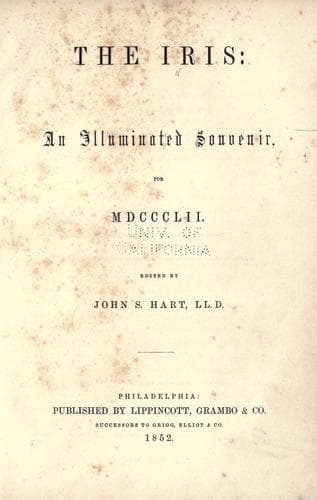
Gift books; Indians of North America -- Literary collections
"On mentioning this and your letter to Mr. G. H. Pond," Dr. W.
continues, "he said, Lieut. Mather, the geologist, who visited this
country (Minesota) with Featherstonhaugh, many years ago, had advanced
the same opinion. In confirmation of it, I would observe, that in the
large prairies up the St. Peter's River, I have often seen buffalo
bones in these circles." Mr. Pond, the Doctor adds, did not think
these circles originated in this way: saying, some supposed they were
caused by a mineral in the soil, and that he had observed, that when
cattle came on or near these circles, they always eat the dark grass in
the ring close to the ground, neglecting or passing over that growing
elsewhere.]
[Footnote 23: The marriage custom of the Sioux is given in "Dacota,
or Legends of the Sioux." The ancient form, as represented in the
illustration, is still venerated, and frequently, though not always
celebrated.]
THE INDIAN MOTHER,
AND THE SONG OF THE WIND.
BY MRS. MARY EASTMAN.
Softly the Indian mother[24] sings--
"Woman's heart is strong,
When she works for those she loves,
Through the summer's day so long.
Hark! to the wind's wild voice, my babe--
What may its story be,
Stirring thy cradle-bed, securely laid
In the arms of the forest tree?"
"We have travelled afar, but we come again;
We have passed o'er the couch of weakness and pain;
We have seen the gifted from earth depart;
We have fanned the brow of the broken heart;
We have fled from the shrieks of the mighty in death,
From the battle's rage and the victor's breath;
We have been at the grave--at the infant's birth;
We know all the cares of the children of earth.
"Our wail is heard o'er the mighty deep,
In whose breast the loved and lost ones sleep,
When, sweeping in rage, the hurricane blast
Tosses to heaven the waters vast.
When we bear o'er the foaming and dashing main
The voices that ne'er will be heard again;
Yet we come and go at His will, who said
To the sea 'Be still!' and its waves obeyed.
"The air was still as we stayed our breath,
While the mother wept o'er her young child's death--
A fatherless child; 'twas peacefully laid,
So placid and calm, 'neath the curtain's shade.
Yet, pressing the clay to her throbbing breast,
'Oh! when,' she cried, 'will I be at rest?'
We sang for the child a requiem low,
And the mother's to sing on our way we go.
Public-domain text, read in full here on John Shaqi.
Reviews
Reviews
No reviews yet
Be the first to share your thoughts on this work.
Elsewhere in the archive
Join the Discussion
Join the discussion
Sign in to leave a comment or review.
Sign InorCreate an account