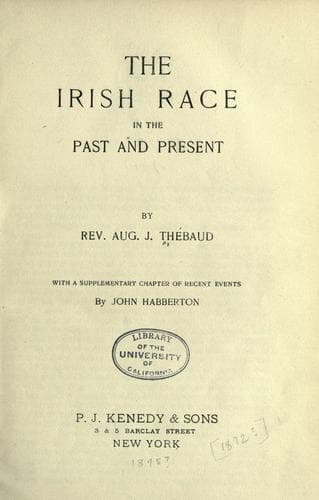
The Irish Race in the Past and the PresentThébaud, Augustus J.
History
The Irish Race in the Past and the Present
Thébaud, Augustus J.
Ireland -- History
May we not conclude, then, that Ireland was much better prepared
for the new religion than any other country; that, when she was
thus admitted by baptism into the European family, she made her
entry in a way peculiar to herself, and which secured to her,
once for all, her firm and undeviating attachment to truth?
She had nothing to change in her manners after having renounced
the few disconnected superstitions to which she had been
addicted. Her songs, her bards, her festivities, her
patriarchal government, her fosterage, were left to her,
Christianized and consecrated by her great apostle; clanship
even penetrated into the monasteries, and gave rise later on to
some abuses. But, perhaps, the saint thought it better to allow
the existence of things which might lead to abuse than violently
and at once to subvert customs, rooted by age in the very nature
of the people, some of which it cost England, later on,
centuries of inconceivable barbarities to eradicate.
As to what exact form, if any, the paganism of the Irish Celts
assumed, we have so few data to build upon that it is now next
to impossible to shape a system out of them. From the passage
of the "Confessio" already quoted, we might infer that they
adored the sun; and this passage is very remarkable as the only
mention anywhere made by St. Patrick of idolatry among the
people. If it was only the emblem of the Supreme Being, then
would there have been nothing idolatrous in its worship; and the
strong terms in which the saint condemns it perhaps need only
express his fear lest the superstition of the ignorant people
might convert veneration into positive idolatry. At all events,
there was not a statue, or a temple, or a theological system,
erected to or connected with it in any shape.
The solemn forms of oaths taken and administered by the Irish
kings would also lead us to infer that they paid a superstitious
respect to the winds and the other elements. But why should
this feeling pass beyond that which even the Christian
experiences when confronted by mysteries in the natural as well
as the supernatural order? The awe-struck pagan saw the
lightning leap, the tempest gather and break over him in
majestic fury; heard the great voice of the mighty ocean which
laved or lashed his shores: he witnessed these wonderful effects;
he knew not whence the tempests or the lightnings came, or the
voice of the ocean; he trembled at the unseen power which moved
them --at his God.
So his imagination peopled his groves and hill-sides, his rivers
and lakes, with harmless fairies; but fairy land has never
become among any nation a pandemonium of cruel divinities; and
we doubt much if such innocuous superstition can be rightly
called even sinful error.
Public-domain text, read in full here on John Shaqi.
Reviews
Reviews
No reviews yet
Be the first to share your thoughts on this work.
Elsewhere in the archive
Join the Discussion
Join the discussion
Sign in to leave a comment or review.
Sign InorCreate an account