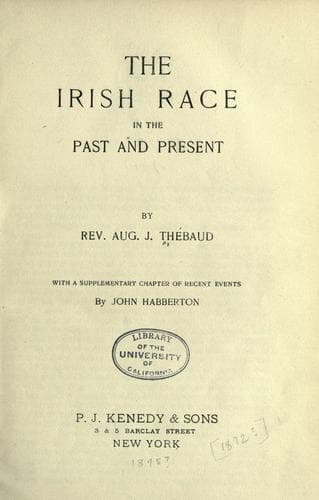
The Irish Race in the Past and the PresentThébaud, Augustus J.
History
The Irish Race in the Past and the Present
Thébaud, Augustus J.
Ireland -- History
Nor was it with Ireland as with Rome, Carthage, Antioch, and
other great cities of Europe, Africa, and Asia. Not the slaves
and artisans alone filled these newly-erected Christian edifices.
Some of the first men of the nation received baptism. We have
already spoken of the family of Laeghaire. In Connaught, at the
first appearance of the man of God, all the inhabitants of that
portion of the province now represented by the County Mayo
became Christians; and the seven sons of the king of the
province were baptized, together with twelve thousand of their
clansmen. In Leinster, the Princes Illand and Alind were
baptized in a fountain near Naas. In Munster, Aengus, the King
of Cashel, with all the nobility of his clan, embraced the faith.
A number of chieftains in Thomond are also mentioned; and the
whole of the Dalcassian tribe, so celebrated before and after in
the annals of Ireland, received, with the waters of baptism,
that ardent faith which nothing has been able to tear from them
to this day.
Many Druids even, by renouncing their superstitions, abdicated
their power over the people. We have mentioned Dubtach ; his
example was followed by many others, among whom was Fingar, the
son of King Clito, who is said to have suffered martyrdom in
Brittany; Fiech, pupil of Dubtach, himself a poet, and belonging
to the noble house of Hy-Baircha in Leinster, was raised by St.
Patrick to the episcopacy, and was the first occupant of the See
of Sletty.
Fiech was a regular member of the bardic order of Druids, a poet
by profession, esteemed as a learned man even before he embraced
Christianity; and during his lifetime he was, as a Christian
bishop, consulted by numbers and regarded as an oracle of truth
and heavenly wisdom.
Nevertheless, Patrick encountered opposition. Some chieftains
declared themselves against him, without daring openly to attack
him. Many Druids, called in the old Irish annals _magi_, tried
their utmost to estrange the Irish people from him. But he stood
in danger of his life only once. It was, in fact, a war of
argument. Long discussions took place, with varied success,
ending generally, however, in a victory for truth.
The final result was that, in the second generation after St.
Patrick, there existed not a single pagan in the whole of
Ireland; the very remembrance of paganism even seemed to have
passed away from their minds ever after; hence arises the
difficulty of deciding now on the character of that paganism.
After its abolition, nothing remained in the literature of the
country, which was at that time much more copious than at
present--nothing was left in its monuments or in the
inclinations of the people--to imperil the existence of the
newly-established Christianity, or of a nature calculated to
give a wrong bias to the religious worship of the people, such
as we have seen was the case in the rest of Europe.
Public-domain text, read in full here on John Shaqi.
Reviews
Reviews
No reviews yet
Be the first to share your thoughts on this work.
Elsewhere in the archive
Join the Discussion
Join the discussion
Sign in to leave a comment or review.
Sign InorCreate an account