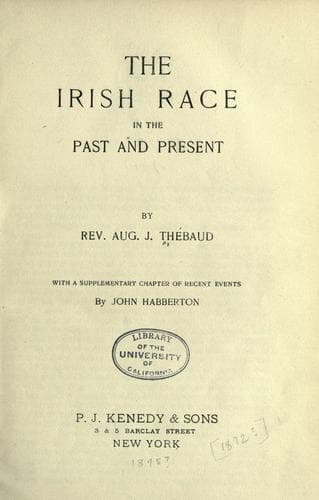
The Irish Race in the Past and the PresentThébaud, Augustus J.
History
The Irish Race in the Past and the Present
Thébaud, Augustus J.
Ireland -- History
In regarding philosophy and its perils in Ireland, our task will
be an easy one, yet not unimportant in its bearings on
subsequent considerations. The minds of nations differ as
greatly as their physical characteristics; and to study the
Irish mind we have only to take into consideration the
institutions which swayed it from time immemorial. They were of
such a nature that they could but belong to a traditional people.
All patriarchal tribes partake of that general character; none,
perhaps, so strikingly as the Celts.
People thus disposed have nothing rationalistic in their nature;
they accept old facts; and, if they reason upon them, it is to
find proofs to support, not motives to doubt them. They never
refine their discussions to hair-splitting, synonymous almost
with rejection, as seems to be the delight of what we call
rationalistic races. It was among these that philosophy was born,
and among them it flourishes. They may, by their acute
reasoning, enlarge the human mind, open up new horizons, and, if
confined within just limits, actually enrich the understanding
of man. We are far from pretending that philosophy has only been
productive of harm, and that it were a blessed thing had the
human intellect always remained, as it were, in a dormant state,
without ever striving to grasp at philosophic truth and raise
itself above the common level; we hold the great names of
Augustine, Anselm, Thomas Aquinas, and so many others, in too
great respect to entertain such an opinion.
Yet it cannot be denied that the excessive study of philosophy
has produced many evils among men, has often been subservient to
error, has, at best, been for many minds the source of a cold
and desponding skepticism.
No race of men, perhaps, has been less inclined to follow those
intellectual aberrations than the Celtic, owing chiefly to its
eminently traditional dispositions.
Before Christianity reached them, the intellectual labors of the
Celts were chiefly confined to history and genealogy, medicine
and botany, law, song, music, and artistic workings in metals
and gems. This was the usual _curriculum_ of Druidic studies.
Astronomy and the physical sciences, as well as the knowledge of
"the nature of the eternal God," were, according to Caesar,
extensively studied in the Gallic schools. Some elements of
those intellectual pursuits may also have occupied the attention
of the Irish student during the twelve, fifteen, or twenty years
of his preparation for being _ordained_ to the highest degree of
ollamh. But the oldest and most reliable documents which have
been examined so far do not allow us to state positively that
such was the case to any great extent.
In Christian times, however, it seems certain that astronomy was
better studied in Ireland than anywhere else, as is proved by
the extraordinary impulse given to that science by Virgil of
Salzburg, who was undoubtedly an Irishman, and educated in his
native country.
Public-domain text, read in full here on John Shaqi.
Reviews
Reviews
No reviews yet
Be the first to share your thoughts on this work.
Elsewhere in the archive
Join the Discussion
Join the discussion
Sign in to leave a comment or review.
Sign InorCreate an account