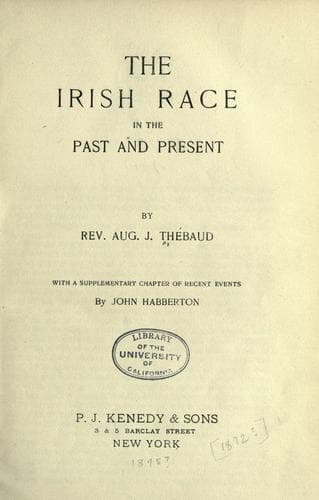
The Irish Race in the Past and the PresentThébaud, Augustus J.
History
The Irish Race in the Past and the Present
Thébaud, Augustus J.
Ireland -- History
It is from the Church alone, therefore, that they received their
highest intellectual training in the philosophy and theology of
the Scriptures and of the Fathers. It is known that, by the
introduction of the Latin and Greek tongues into their schools
in addition to the vernacular, the Bible in Latin and Greek, and
the writings of many Fathers in both languages, as also the most
celebrated works of Roman and Greek classical writers, became
most interesting subjects of study. They reproduced those works
for their own use in the _scriptoria_ of their numerous
monasteries. We still possess some of those manuscripts of the
sixth and following centuries, and none more beautiful or
correct can be found among those left by the English, French, or
Italian monastic institutions of the periods mentioned.
During the seventh, eighth, and ninth centuries, the Irish
schools became celebrated all over Europe. Young Anglo-Saxons of
the best families were sent to receive their education in
Innisfail, as the island was then often called; and, from their
celebrated institutions of learning, numerous teachers and
missionaries went forth to England, Germany (along the Rhine,
chiefly), France, and even Switzerland and Italy.
Yet, in the history of all those intellectual labors, we never
read of startling theories in philosophy or theology advanced by
any of them, unless we except the eccentric John Scotus Erigena,
whom Charles the Bald, at whose court he resided, protected even
against the just severity of the Church. Without ever having
studied theology, he undertook to dogmatize, and would perhaps
have originated some heresy, had he found a following in Germany
or France.
But he is the only Irishman who ever threatened the peace of the
Church, and, through her, of the world. Duns Scotus, if he were
Irish, never taught any error, and remained always an accepted
leader in Catholic schools. To the honor of Erin be it said, her
children have ever been afraid to deviate in the least from the
path of faith. And it would be wrong to imagine that the
preservation from heresy so peculiar to them, and by which they
are broadly distinguished from all other European nations, comes
from dulness of intellect and inability to follow out an
intricate argumentation. They show the acuteness of their
understanding in a thousand ways; in poetry, in romantic tales,
in narrative compositions, in legal acumen and extempore
arguments, in the study of medicine, chiefly in that masterly
eloquence by which so many of them are distinguished. Who shall
say that they might not also have reached a high degree of
eminence in philosophical discussions and ontological theories?
They have always abstained from such studies by reason of a
natural disinclination, which does them honor, and which has
saved them in modern times, as we shall see in a subsequent
chapter, from the innumerable evils which afflict society
everywhere else, and by which it is even threatened with
destruction.
Public-domain text, read in full here on John Shaqi.
Reviews
Reviews
No reviews yet
Be the first to share your thoughts on this work.
Elsewhere in the archive
Join the Discussion
Join the discussion
Sign in to leave a comment or review.
Sign InorCreate an account