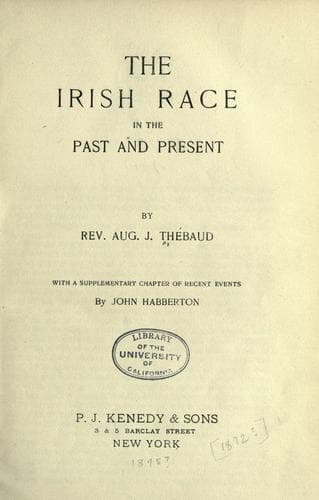
The Irish Race in the Past and the PresentThébaud, Augustus J.
History
The Irish Race in the Past and the Present
Thébaud, Augustus J.
Ireland -- History
Hence, according to Probus, the magicians to whom the arrival of
Patrick had been foretold, prepared themselves for the contest,
and several chieftains supported them. Prestiges were, therefore,
tried in antagonism to miracles; but, as Moses prevailed over
the power of the Egyptian priests, so did Patrick over the
Celtic magicians. It is even said that five Druids perished in
one of the contests.
The princes were sometimes also punished with death. Recraid,
head of a clan, came with his Druids and with words of
incantation written under his white garments; he fell dead.
Laeghaire himself, the Ard-Righ of all Ireland, whose family
became Christian, but who refused to abandon his superstitions,
perished with his numerous attendants.
But a more singular phenomenon was, that death, which was often
the punishment of unbelief, became as often a boon to be desired
by the new Christian converts, so completely were they under the
influence of the supernatural. Thus Ruis found it hard to
believe. To strengthen his faith, Patrick restored to him his
youth, and then gave him the choice between this sweet blessing
of life and the happiness of heaven; Ruis preferred to die, like
Ethne and Felimia.
Sechnall, the bard, told St. Patrick, one day, that he wished to
sing the praises of a saint whom the earth still possessed.
"Hasten, then," said Patrick, "for thou art at the gates of
death." Sechnall, not only undisturbed, but full of joy, sang a
glorious hymn in honor of Patrick, and immediately after died.
Kynrecha came to the convent-door of St. Senan. "What have women
in common with monks?" said the holy abbot. "We will not receive
thee." "Before I leave this place," responded Kynrecha, "I offer
this prayer to God, that my soul may leave the body." And she
sank down and expired.
The various lives of the apostle of Ireland and his successors
are full of facts of this nature. Supposing that a high coloring
was given to some of these by the writers, one thing is certain:
the people who lived during that apostleship believed in them
firmly, and handed down their belief to their children. Moreover,
nothing was better calculated to give to a primitive people,
like the Irish, a strong supernatural spirit and character, than
to make them despise the joys of this earth and yearn for a
better country.
There are, indeed, too many facts of a similar kind related in
the lives of St. Patrick and his fellow-workers, to bear the
imputation, not of imposition, but even of delusion. The desire
of dying, to be united with Christ; the indifference, at least,
as to the prolongation of existence; the readiness, if not the
joy, with which the announcement of death was received, are of
such frequent mention in those old legends, as matters of
ordinary occurrence, surprising no one, that they must be
conceded as facts often taking place in those early ages.
Public-domain text, read in full here on John Shaqi.
Reviews
Reviews
No reviews yet
Be the first to share your thoughts on this work.
Elsewhere in the archive
Join the Discussion
Join the discussion
Sign in to leave a comment or review.
Sign InorCreate an account