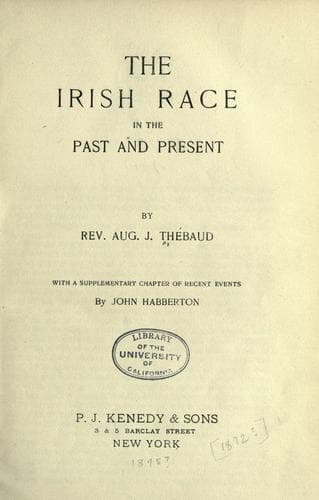
The Irish Race in the Past and the PresentThébaud, Augustus J.
History
The Irish Race in the Past and the Present
Thébaud, Augustus J.
Ireland -- History
And, more striking still, this feeling of accepting death,
either as a boon or as a matter of course, and with perfect
resignation to the will of God, seems to have been throughout,
since the introduction of Christianity, a characteristic of the
Irish people. It is often witnessed in our own days, and
manifested, equally by the young, the middle-aged, or the old.
The young, closing their eyes to that bright life whose
sweetness they have as yet scarcely tasted, never murmur at
being deprived of it, though hope is to them so alluring; the
middle-aged, called away in the midst of projects yet
unaccomplished, see the sudden end of all that before interested
them, with no other concern than for the children they leave
behind them; the old, among other races generally so tenacious
of life, are, as a rule, glad that their last hour has come, and
speak only of their joy that at last they "go home" to that
country whither so many of their friends and kindred have gone
before them.
This in itself would stamp the Celtic character with an
indelible mark, distinguishing it from all other, even most
Christian, peoples.
The second sign we find of the firm hold the supernatural had
taken of the Irish from the very beginning is their strong
belief in the power of the priesthood. This is so striking among
them that they have been called by their enemies and those of
the Church "a priest-ridden people." Let us consider if this is
a reproach.
If Christianity be true, what is the priesthood? Even among the
Greeks, from whom so many heresies formerly sprang before they
were smitten into insignificance by schism and its punishment--
Turkish slavery--when the great doctors sent them by Providence
spoke on the subject, what were their words, and what impression
did they make on their supercilious hearers? St. John Chrysostom
will answer. His long treatise, written to his friend Basil, is
but a glowing description of the great privileges given to the
Christian priest by the High-Priest himself--Christ our Lord.
When the great preacher of Antioch, though not yet a priest,
describes the awful moment of sacrifice, the altar surrounded by
angels descended from heaven, the man consecrated to an office
higher than any on earth, and as high as that of the incarnate
Son of God--God himself coming down from above and bringing down
heaven with him--who can believe in Christianity and fail to be
struck with awe?
Public-domain text, read in full here on John Shaqi.
Reviews
Reviews
No reviews yet
Be the first to share your thoughts on this work.
Elsewhere in the archive
Join the Discussion
Join the discussion
Sign in to leave a comment or review.
Sign InorCreate an account