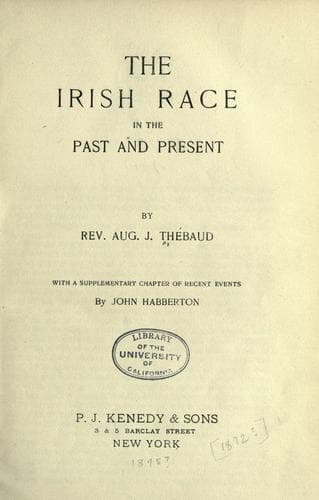
The Irish Race in the Past and the PresentThébaud, Augustus J.
History
The Irish Race in the Past and the Present
Thébaud, Augustus J.
Ireland -- History
But, even in our days, we are furnished with an ocular
demonstration of what men could scarcely bring themselves to
believe, or at least would term an exaggeration, did not
standing proof remain. God inspired his children with the
thought of erecting more substantial structures, of building
walls of stone and roofing them in with tiles and metal; and the
island was literally covered, not with Gothic castles or
luxurious palaces and sumptuous edifices, but with large and
commodious buildings and churches, wherein the religious life of
the inmates might be carried on with greater comfort and
seclusion from the world.
At the time of the Reformation all those asylums of perfection
and asceticism were of course profaned, converted to vile or
slavish uses, many altogether destroyed to the very foundations;
a greater number were allowed to decay gradually and become
heaps of ruins.
And what happened when the English Government, unable any longer
to resist public opinion, was compelled to consent that a survey
be made of the poor and comparatively few remains still in
existence, in order to manifest a show of interest for the past
history of the island; when commissioners were appointed to
publish lists and diagrams of the former dwellings of the
"saints," which the "zeal" of the "reformers" had battered down
without mercy? To the astonishment of all, it was proved by the
ruins still in existence that the greater portion of the island
had been once occupied by monasteries and convents of every
description. And Prof. O'Curry has stated his conviction, based
on local traditions and geographical and topographical names,
that a great number of these can be traced back to Patrick and
his first companions.
It is clear enough, then, that, from the beginning, the Irish
were not only "priest-ridden," but also very attached to
"monkish superstitions."
Yet we could not form a complete idea of that attachment were we
to limit ourselves to an enumeration of the buildings actually
erected, supposing such an enumeration possible at this time.
For we know, by many facts related in Irish hagiology, that a
great number of those who devoted themselves to a life of
penance and austerity, did not dwell even in the humble
structures of the first monks, but, deeming themselves unworthy
of the society of their brethren, or condemned by a severe but
just "friend of their soul," as the confessor was then called,
hid themselves in mountain-caves, in the recesses of woods or
forests, or banished themselves to crags ever beaten by the
waves of the sea.
Yes, there was a time when those dreadful solitudes of the
Hebrides, which frighten the modern tourist in his summer
explorations, teemed with Christian life, and every rock, cave,
and sand-bar had its inhabitant, and that inhabitant an Irish
monk.
Public-domain text, read in full here on John Shaqi.
Reviews
Reviews
No reviews yet
Be the first to share your thoughts on this work.
Elsewhere in the archive
Join the Discussion
Join the discussion
Sign in to leave a comment or review.
Sign InorCreate an account