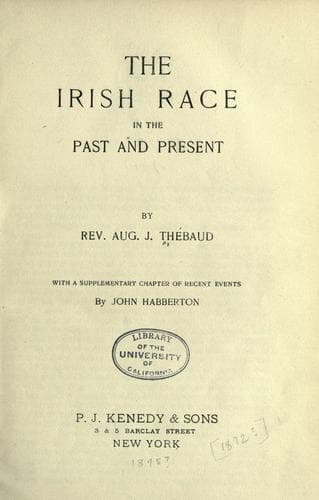
The Irish Race in the Past and the PresentThébaud, Augustus J.
History
The Irish Race in the Past and the Present
Thébaud, Augustus J.
Ireland -- History
Another and a stronger fact still, exemplifying the extent to
which the Irish have at all times carried their devotion to the
supernatural character of the Christian religion, is the
extraordinary ardor with which, from the very beginning, they
rushed into the high path of perfection, called the way of
"evangelical counsels." Nowhere else were such scenes ever
witnessed in Christian history.
For the great mass of people the common way of life is the
practice of the commandments of God; it is only the few who feel
themselves called on to enter upon another path, and who
experience interiorly the need of being "perfect."
In Ireland the case was altogether different from the outset. St.
Patrick, notwithstanding his intimate knowledge of the leanings
of the race, expresses in his "Confessio" the wonder and delight
he experienced when he saw in what manner and in what numbers
they begged to be consecrated to God the very first day after
their baptism. Yet were they conscious that this very eagerness
would excite the greater opposition on the part of their pagan
relatives and friends. Thus we read of the fate of Eochad's
daughters, and the story of Ethne and Felimia.
The whole nation, in fact, appeared suddenly transported with a
holy impetuosity, and lifted at once to the height of Christian
life. Monasteries and nunneries could not be constructed fast
enough, although they contented themselves with the lightest
fabrics--wattles being the ordinary materials for walls, and
slender laths for roofs.
Nor was this an ephemeral ardor, like a fire of stubble or straw,
flashing into a momentary blaze, to relapse into deeper gloom.
It lasted for several centuries; it was still in full flame at
the time of Columba, more than two hundred years after Patrick;
it grew into a vast conflagration in the seventh and eighth
centuries, when multitudes rushed forth from that burning island
of the blest to spread the sacred fire through Europe.
How the nation continued to multiply, when so many devoted
themselves to a holy celibacy, is only to be explained by the
large number of children with which God blessed those who
pursued an ordinary life, and who, from what is related in the
chronicles of the time, must have been in a minority.
Of the first monasteries and convents erected not a single
vestige now remains, because of the perishable materials of
which they were constructed; yet each of them contained hundreds,
nay thousands, of monks or nuns.
Public-domain text, read in full here on John Shaqi.
Reviews
Reviews
No reviews yet
Be the first to share your thoughts on this work.
Elsewhere in the archive
Join the Discussion
Join the discussion
Sign in to leave a comment or review.
Sign InorCreate an account