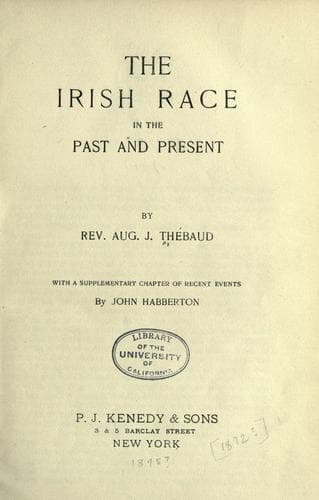
The Irish Race in the Past and the PresentThébaud, Augustus J.
History
The Irish Race in the Past and the Present
Thébaud, Augustus J.
Ireland -- History
According to the common opinion, each founder of a monastery had
his own rule, which he himself was the first to follow in all
its rigor; if disciples came, they were to observe it, or go
elsewhere; if, after having embraced it, they found themselves
unable to keep it to the letter, the abbot was indulgent, and
did not impose on them a burden which they could no longer bear,
after having first proved their willingness to practise it.
Thus, it is reported that St. Mochta was the only one who
practised his own rule exactly, his monks imitating him as well
as they could. St. Fintan, who was inclined to be severe,
received this warning in a vision: "Fight unto the end thyself;
but beware of being a cause of scandal to others, by requiring
all to fight as thou doest, for one clay is weaker than another."
Thus, every founder, every abbot even, left to the guidance of
the Holy Spirit, practised austerities which in our days of self-
indulgence seem absolutely incredible, and showed themselves
severe to those under their authority. But this severity was
tempered by such zeal for the good of souls, and consequently by
such an unmistakable charity, that the penitent monk carried his
burden not only with resignation, but with joy. This, in after-
ages, became a characteristic feature of Irish monasticism.
The life of Columba is full of examples of this holy severity.
In St. Patrick's life we read that Colman died of thirst rather
than quench it before the time appointed by his master.
How many facts of a similar nature might be mentioned! Enough to
say that, after so many ages, in which, thanks to barbarous
persecutions, all ecclesiastical and monastic traditions were
lost to Ireland, through the sheer impossibility of following
them up, the Irish still show a marked predilection for the holy
austerity of penance, though the rest of the Christian world
seems to have almost totally forgotten it.
But if the Irish convents lacked system, there was at the same
time in them an exuberance of feeling, an enthusiastic impulse,
which is to be found nowhere else to the same extent, and which
we call their second peculiar feature after they received
Christianity. This is beautifully expressed in a hymn of the
office of St. Finian: "Behold the day of gladness; the clerks
applaud and are in joy; the sun of justice, which had been
hidden in the clouds, shines forth again."
As soon as this primitive enthusiasm seemed to slacken in the
least, reformers appeared to enkindle it again. Such was Bridget,
such was Gildas, such were the disciples of St. David of
Menevia in Wales, such was any one whom the Spirit of God
inspired with love for Ireland. Thus the scenes enacted in the
time of Patrick were again and again repeated.
And when a monastery was built, it was not properly a monastery,
but a city rather; for the whole country round joined in the
goodly work. As some one has said, "it looked as if Ireland was
going to cease to be a nation, and become a church."
Public-domain text, read in full here on John Shaqi.
Reviews
Reviews
No reviews yet
Be the first to share your thoughts on this work.
Elsewhere in the archive
Join the Discussion
Join the discussion
Sign in to leave a comment or review.
Sign InorCreate an account