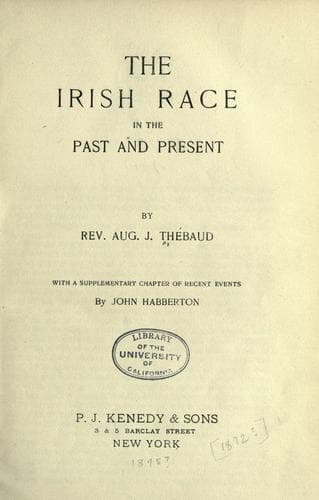
The Irish Race in the Past and the PresentThébaud, Augustus J.
History
The Irish Race in the Past and the Present
Thébaud, Augustus J.
Ireland -- History
With regard to the question of ground and the appropriation of
landed property, what matters it who is the owner? If it be clan
territory, there is the clan with nothing but welcome, applause,
and assistance. If it be private, the owner is not consulted
even; how could he think of opposing the work of God? Thus, we
never read in Irish history - in the earlier stages at least -
of those long charters granted in other lands by kings, dukes,
and counts, and preserved with such care in the archives of the
monastery. It seems that the Danes, after they became Christians,
were the first to introduce the custom; after them, the Anglo-
Normans, in the true spirit of their race, made a flourishing
business of it. The Irish themselves never thought of such at
first. There was no fear of any one ever claiming the ground on
which God's house stood. The buildings were there: the ground
needed to support them: what Irishman could think of driving
away the holy inmates and pulling the walls about their ears?
The whole surrounding population is busy erecting them. Long
rows of wattles and tessel-work are set in right order; over
them a rough roof of boards; within small cells begin to appear,
as the slight partitions are erected between them. Symmetry or
no symmetery, the position of the ground decides the question;
for there is no need of the skill of a surveyor to establish the
grade. Does not the rain run its own way, once it begins?
How far and how wide will those long rows reach? They seem the
streets of a city; and in truth they are. The place is to
receive two, three thousand monks, over and above the students
committed to their care. And, in addition to the cells to dwell
in, there are the halls wherein to teach; the museums and
repositories of manuscripts, of sacred objects; the rooms to
write in, translate, compose; the sheds to hold provisions, to
prepare and cook them, ready for the meal.
For the most important edifice--the temple of God--alone stones
are cut, shaped, and fitted each to each with care and precision.
A holy simplicity surrounds the art; yet are there not wanting
carven crosses and other divine emblems sculptured out. Within,
the heavenly mysteries of religion will be performed. Should you
ask, "Why so small?" the answer is ready. That large space empty
around holds room enough for the worshippers, whose numbers
could be accommodated in no edifice. The minds of Irish
architects had not yet expanded to the conception of a St.
Peter's. Inside is room enough for the ministers of religion;
without, at the tinkling of the bell, in the round tower
adjoining, the faithful will join in the services.
Public-domain text, read in full here on John Shaqi.
Reviews
Reviews
No reviews yet
Be the first to share your thoughts on this work.
Elsewhere in the archive
Join the Discussion
Join the discussion
Sign in to leave a comment or review.
Sign InorCreate an account