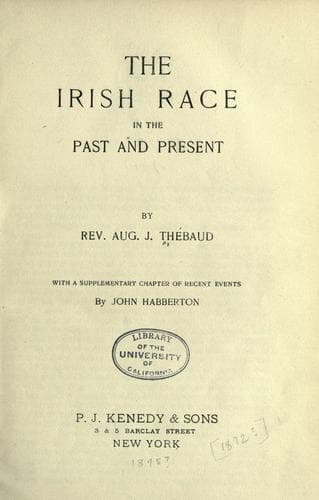
The Irish Race in the Past and the PresentThébaud, Augustus J.
History
The Irish Race in the Past and the Present
Thébaud, Augustus J.
Ireland -- History
With regard to their country, also, grace came to the aid of
Nature; the supernatural was, therefore, seldom absent from the
natural in their minds, and something of this double union has,
remained in them in every sense, and has, no doubt, contributed
to render their nationality imperishable in spite of persecution.
How ardent and pure in the heart of Columba was the love of
Ireland, from which he was a voluntary exile! Patrick, also,
though not native born, yielded to none in that sacred feeling;
one of the three things he sought of God on dying was, that Erin
should not "remain forever under a foreign yoke:" Kieran offered
the same prayer, and their reason for thus praying was that she
was the "island of saints," destined to help out the salvation
of many.
Religion has been invariably connected with that acute sentiment
ever present in the minds of Irishmen for their country; and it
is, doubtless, that holy and supernatural feeling which has
preserved a country which enemies strove so strenuously to wrest
from them.
But it was not love of country alone, of relatives and friends,
which enkindled in their hearts a spirit of enthusiasm; their
whole monastic life was one of high-spirited devotedness, and
energy, and action, more than human.
We see them laboring in and around their monastic hive. How they
pray and chant the divine office; how they study and expound the
holy doctrine to their pupils; how they are ever travelling,
walking in procession by hundreds and by thousands through the
island, the interior spirit not allowing them to stand still.
There are so many pilgrimages to perform, so many shrines to
venerate, so many works of brotherly love to undertake. Other
monks in other countries, indeed, did the same, but seldom with
such universal ardor. The whole island, as we said, is one
church. On all sides you may meet bishops, and priests, and
monks, bearing revered relics, or proceeding to found a new
convent, plant another sacred edifice, or establish a house for
the needy. The people on the way fall in and follow their
footsteps, sharers of the burning enthusiasm. Many-how many!-
were thus attracted to this mode of life, wherein there was
scarce aught earthly, but all breathing holiness and heavenly
grace!
Thus the island was from the beginning a holy island. But zeal
for God in their own country alone not being enough for their
ardor, those men of God were early moved by the impulse of going
abroad to spread the faith. Volumes might be written of their
apostleship among barbarous tribes; we have room only for a few
words.
They first went to the islands north of them, to the Hebrides,
the Faroe Isles, and even Iceland, which they colonized before
the Norwegian pirates landed there. Then they evangelized
Scotland and the north of England; and, starting from
Lindisfarne, they completed the work of the conversion of the
Anglo-Saxons, which was begun by St. Augustin and his monks in
the south.
Public-domain text, read in full here on John Shaqi.
Reviews
Reviews
No reviews yet
Be the first to share your thoughts on this work.
Elsewhere in the archive
Join the Discussion
Join the discussion
Sign in to leave a comment or review.
Sign InorCreate an account